
 United States
The most expensive packaging insert is not always the best one. A thick foam insert may look premium, but it can add unnecessary cost to a lightweight product. A cardboard insert may be recyclable, yet fail if the product is heavy, delicate, or exposed to moisture.
The right packaging inserts depend on what must happen inside the box. The product should remain still, survive handling, and look presentable when the customer opens it. Material cost, storage space, packing speed, and disposal also matter.
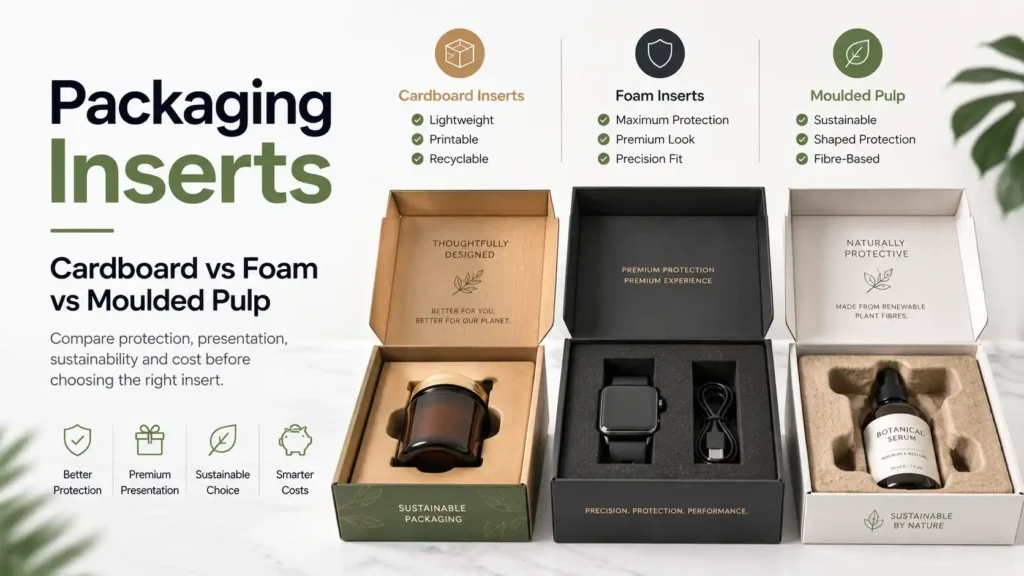
For most UK brands, the choice comes down to three main materials:
- Die-cut cardboard
- Protective foam
- Moulded pulp
Each option solves a different packaging problem.
Cardboard vs Foam vs Moulded Pulp at a Glance
| Insert material | Best for | Main benefits | Main limitations |
| Cardboard | Cosmetics, candles, food jars, retail products and subscription boxes | Lightweight, printable, space-efficient and widely recyclable when designed correctly | Less suitable for severe impact, moisture or very heavy products |
| Foam | Electronics, tools, instruments, glassware and premium gift sets | Strong cushioning, precise product retention and a premium appearance | Harder to recycle and can increase material cost |
| Moulded pulp | Electronics, bottles, beauty products, homeware and high-volume retail goods | Protective, fibre-based and suitable for shaped cavities | Tooling and production setup may be less practical for smaller runs |
There is no single winner. Cardboard often provides the best balance of cost, branding and recyclability. Foam offers the strongest controlled cushioning. Moulded pulp works well when shaped protection and fibre-based presentation are priorities.
What Are Packaging Inserts?
Packaging inserts are components placed inside a box to hold, separate, protect or present a product.
A structural insert can:
- Stop a product moving during delivery
- Separate several items in one box
- Reduce contact between delicate surfaces
- Hold bottles or jars upright
- Create a tidy product presentation
- Support accessories, cables or instruction booklets
- Reduce the need for loose void fill
The term can also describe printed materials placed inside an order. These include packaging insert cards, care instructions, thank-you cards, discount offers and review requests.
Structural inserts and printed cards serve different purposes. One protects and positions the product. The other communicates with the customer. Many successful ecommerce packs use both.
Cardboard Inserts Offer Flexibility Without Excess Weight
Die-cut cardboard inserts are cut, creased, and folded to create compartments, platforms, and product supports. They can be made from folding carton board, kraft board, or corrugated material depending on the required strength.
Corrugated board contains a fluted layer between flat liners. The flute helps provide cushioning and compression resistance, while different flute sizes affect strength, thickness, and print quality.
When cardboard works best
Cardboard inserts are a practical choice for:
- Cosmetics and skincare products
- Candles and fragrance bottles
- Confectionery and food jars
- Subscription box products
- Small homeware items
- Clothing accessories
- Product samples
- Retail gift sets
- Lightweight electronics
They are especially useful when the insert must do more than protect the item. Cardboard can also carry printed instructions, product names, brand colours or disposal information.
Benefits of cardboard inserts
Lower shipping weight
Cardboard is usually lighter than dense foam. Lower pack weight can help control delivery costs, especially when products are shipped in volume.
Efficient storage
Many cardboard inserts can arrive flat and be assembled during packing. This reduces the amount of warehouse space needed compared with bulky pre-formed inserts.
Better print options
Cardboard provides a useful surface for colour printing, logos and simple instructions. Interior printing can create a stronger customer unboxing experience without adding another loose card.
Easier material separation
A box and insert made from compatible paper-based materials can be easier for customers to sort than packaging that combines board, foam and several plastic components.
UK recyclability guidance encourages fibre-based packaging designers to limit non-paper components and consider how coatings, laminates and other additions affect recycling.
Limitations of cardboard
Cardboard is not automatically suitable for every product.
It may lose strength when exposed to moisture. Thin board can also bend under a heavy item or collapse if the design places pressure in the wrong area.
A cardboard insert should be designed around the product’s weight, shape and weak points. Adding more board does not always improve protection. Strategic folds, ribs and locking tabs often create better strength with less material.
Foam Inserts Provide Precise Cushioning
Foam inserts are commonly cut from EVA, polyethylene or polyurethane foam. Different foams vary in density, firmness, cell structure and surface texture.
Closed-cell EVA foam is valued for cushioning, durability and relatively low water absorption. It can be cut into precise cavities for products that must remain firmly positioned.
When foam works best
Foam may be the better choice for:
- Electronic devices
- Test equipment
- Medical or technical instruments
- Glass bottles
- Tools and components
- Watches and jewellery
- Presentation samples
- Collectable products
- Products with several delicate parts
The main advantage is control. A well-designed foam cavity can support a product around selected areas while protecting fragile edges, screens, switches and finishes.
Benefits of foam inserts
Strong shock absorption
Foam can compress during impact and reduce the force transferred to the product.
Accurate product fit
Computer-controlled cutting allows cavities to follow unusual product shapes. Separate recesses can hold cables, parts and accessories.
Premium presentation
Dark, clean-cut foam is often used in luxury boxes and technical presentation kits. It creates a strong visual contrast and keeps each component in a fixed position.
Resistance to repeated handling
Some foam materials recover after compression and can support products that are removed and returned to the box several times.
Limitations of foam
Foam can be more difficult for customers to recycle through normal household collections. It may also make the pack look wasteful when used for a simple, low-risk product.
Dense foam increases material use and may raise production costs. It also takes up storage space because most foam inserts cannot be supplied flat.
The surface must be tested against the product. A poorly chosen foam can grip delicate coatings, leave marks or place pressure on fragile parts. The cavity should hold the product securely without forcing the customer to pull hard to remove it.
Moulded Pulp Combines Shape With Fibre-Based Protection
Moulded pulp inserts are produced by forming paper fibres into a shaped tray or support. The familiar egg carton is a basic example, although modern moulded pulp packaging can have much finer surfaces and more complex shapes.
The material is commonly made using recycled paper or cardboard fibres mixed with water, formed in tooling and dried into a rigid shape. It can provide product separation, impact absorption and stacking support.
When moulded pulp works best
Moulded pulp inserts are often used for:
- Consumer electronics
- Beauty products
- Bottles and containers
- Ceramics and homeware
- Small appliances
- Food and produce
- Multi-product retail packs
- High-volume ecommerce goods
It works well when the insert needs a three-dimensional shape, but the brand prefers a fibre-based material rather than plastic foam.
Benefits of moulded pulp inserts
Shaped product support
Moulded cavities can hold rounded, irregular or multi-part products more securely than a simple folded board platform.
Fibre-based presentation
The natural texture suits brands that want packaging to feel simple, practical and material-conscious.
Good protection at scale
Once tooling and production are established, moulded pulp can be effective for repeat orders with consistent product dimensions.
Stackable supply
Moulded trays can often nest inside one another. This may reduce storage volume compared with some bulky foam designs.
Limitations of moulded pulp
The tooling stage requires accurate product dimensions and a stable design. A late change to the bottle, lid, accessory or product shape may require tooling changes.
Fine details can also be harder to achieve than with precision-cut foam. The surface may feel rougher, which matters when packaging polished, coated or easily scratched items.
Moulded pulp normally makes more commercial sense when order quantities justify the development work. A die-cut cardboard insert may offer more flexibility for a small business testing a new product or changing its range frequently.
Cardboard vs Foam Packaging Inserts: The Key Trade-Offs
A useful comparison should consider the whole packing process, not only the price of one insert.
| Decision factor | Cardboard | Foam | Moulded pulp |
| Cushioning | Moderate and design-dependent | High | Moderate to high |
| Precise product fit | Good | Excellent | Very good |
| Print quality | Excellent | Limited | Limited |
| Moisture resistance | Low to moderate | Usually high for closed-cell foam | Low to moderate |
| Flat storage | Often possible | Rarely possible | Not flat, but may nest |
| Premium appearance | Clean and customisable | High-end and technical | Natural and minimal |
| Household recyclability | Often stronger when coatings and mixed materials are limited | Usually more difficult | Often favourable, subject to additives and local collection |
| Small production runs | Often practical | Can be practical for simple cut shapes | May be less economical |
| High-volume repeat production | Strong option | Strong option | Strong option once tooled |
| Product changes | Easier to revise | Cavities may require recutting | Tooling may need changing |
How to Choose the Right Packaging Insert Material
Choosing between the different types of packaging inserts starts with the product, not the appearance of the box.
1. Assess the real delivery risk
A product sold in a shop faces different risks from one travelling through a courier network.
Consider:
- Drops from sorting belts or delivery vehicles
- Vibration during road transport
- Boxes stacked in warehouses
- Pressure from other parcels
- Changes in temperature or humidity
- Rough manual handling
- Returns using the original packaging
Fragile, expensive products usually need tighter retention and stronger cushioning. Lightweight products may only need enough support to prevent movement.
2. Identify the product’s strong and weak areas
An insert should hold the product where it can accept pressure.
Avoid placing retention points directly against:
- Glass edges
- Buttons or switches
- Pump dispensers
- Decorative trims
- Thin lids
- Screens
- Hinges
- Easily scratched surfaces
Measure the widest point of the real production item. Do not rely only on a digital drawing. Caps, labels, seals, and normal manufacturing variation can change the final dimensions.
3. Consider the customer’s removal experience
A product can fit perfectly and still be frustrating to open.
Useful design details include:
- Finger notches
- Pull ribbons
- Thumb cuts
- Flexible side tabs
- Clear accessory compartments
- Space around delicate handles
- Logical product orientation
The item should stay secure during delivery but lift out without force.
4. Check the total packing cost
The cheapest unit price may create higher costs elsewhere.
Include:
- Assembly time
- Warehouse storage
- Damaged product rates
- Packing errors
- Material waste
- Shipping weight
- Tooling charges
- Replacement costs
- Customer complaints
A complex folded insert may save material but slow the packing line. Foam may cost more per unit but reduce damage to a high-value product.
5. Match the material to the brand promise
Packaging affects how customers judge the product before using it.
- Kraft cardboard can feel natural and practical.
- Printed board can feel colourful and retail-ready.
- Black foam can feel technical or premium.
- White moulded fibre can create a clean, modern appearance.
- Natural pulp can support a low-plastic brand position.
The visual style must still suit the level of protection required. Presentation cannot compensate for products arriving damaged.
6. Plan for disposal
Avoid vague environmental claims. Explain what the material is and how customers should dispose of it.
For businesses covered by UK Extended Producer Responsibility rules, packaging data and recyclability can also affect reporting and costs. UK policy is moving towards disposal fees that vary according to recyclability, which gives brands another reason to remove unnecessary components and improve material choices.
Packaging Inserts for Small Businesses
Small brands often need flexibility more than the lowest possible high-volume price.
A practical starting point may be:
- A simple die-cut cardboard insert
- One or two product sizes
- Minimal lamination
- A standard box structure
- A printed thank-you or care card
- A prototype before the full order
This approach allows the business to test customer response and packing performance before investing in complex tooling.
Small companies should also think about packing labour. An attractive insert with six tabs and several folds may become expensive when every order is assembled by hand.
The best packaging inserts for small businesses are usually easy to understand, quick to pack, and simple to reorder.
Ecommerce Packaging Inserts Should Support the Full Order
Good Ecommerce packaging insert ideas go beyond holding one item in place.
An insert can be designed to:
- Keep several products separated
- Prevent bottles turning sideways
- Present a gift set in a fixed order
- Hide paperwork beneath a product platform
- Create space for samples
- Hold a product care card
- Support a refill or repeat-purchase message
- Reduce loose paper or plastic filling
The outer box and internal insert must be tested together. A strong insert inside a weak outer carton will not prevent crushing. A strong box with too much space may still allow the product to build momentum before an impact.
The completed package should be tested in the same condition used for dispatch, including the product, insert, accessories, cards, tape and outer carton.
Printed Insert Cards Add Value After Delivery
Structural protection is only one part of the unboxing experience. Printed inserts help customers understand the product and decide what to do next.
Useful options include:
Care instruction cards
Care instruction cards reduce uncertainty after purchase. They can cover cleaning, storage, assembly, washing, or safe use.
For products with detailed instructions, a QR code packaging insert can link to a video, downloadable manual, or troubleshooting page. The destination page should be mobile-friendly and remain active for the life of the product.
Thank-you cards
Simple Thank-you for your purchase cards can make a small brand feel more personal.
Effective small business thank-you card wording is usually brief:
Thank you for supporting our business. Your order was packed with care, and we hope you enjoy it.
Avoid filling the card with several offers, hashtags and requests. One clear message feels more genuine.
Review and referral cards
Review request cards should make the process easy. Include a short link or QR code and explain where the review can be left.
Referral cards for small businesses can work when the benefit is clear for both the existing customer and the new buyer. Discount code cards should use simple terms, a visible expiry date, and a code that is easy to type.
A printed insert should serve one main purpose. Too many calls to action compete with each other and weaken the message.
How to Design Packaging Inserts That Work in Practice
A reliable insert usually moves through the following process.
- Measure the physical product. Include labels, closures, caps and accessories.
- Define the risks. Identify impact points, fragile areas and likely movement.
- Choose the retention method. Decide whether the product needs cushioning, blocking, separation or all three.
- Select the material. Balance strength, appearance, storage and disposal.
- Create a structural prototype. Check the fit before approving a full order.
- Test product removal. Make sure customers can lift the product without damage.
- Run a packing trial. Ask the people packing orders to assemble several units.
- Test the complete parcel. Use the final box, insert, product and closure method.
- Adjust before production. Small changes to a tab or cavity can prevent repeated packing problems.
A screen proof can check artwork, but it cannot confirm product fit. Physical prototyping is essential when the insert has tight tolerances or protects an expensive item.
Common Packaging Insert Mistakes
Making the fit too tight
A tight cavity may look secure but can damage labels, coatings or fragile edges. It may also become unusable when product dimensions vary slightly between batches.
Using more material than needed
Thicker does not always mean safer. Protection depends on where the material is placed and how it behaves during impact.
Ignoring the packing team
An insert that is difficult to fold or easy to assemble incorrectly creates delays and inconsistent presentation.
Mixing materials without a clear reason
A cardboard box, plastic window, laminated insert and foam pad may be difficult for customers to separate. Each added material should solve a real problem.
Approving artwork before the structure
Graphics should follow the final cutting outline. Structural changes made after artwork approval can move text, logos, or QR codes into folds and cut areas.
Skipping transit testing
A product that looks secure on a desk can still move during repeated drops and vibration. Test the completed parcel before placing a large order.
Which Packaging Insert Should You Choose?
Choose die-cut cardboard inserts when:
- The product is light to moderately heavy
- Strong printing and branding matter
- Flat storage would help
- Order quantities are small or medium
- A paper-based format suits the brand
Choose foam inserts when:
- The product is fragile or high value
- Precise cushioning is essential
- The packaging may be reused
- Moisture resistance matters
- A technical or luxury presentation is required
Choose moulded pulp inserts when:
- A shaped fibre-based tray is preferred
- The product range is stable
- Volumes justify tooling
- Nesting can support storage efficiency
- Natural texture suits the brand presentation
Some products benefit from a hybrid design. A cardboard platform may hold the main item while a small foam pad protects one delicate component. Use mixed materials only where the extra protection justifies the added complexity.
Custom Packaging Inserts for UK Products
99 Custom Boxes UK creates packaging in custom sizes, materials and finishes for retail, ecommerce and gift products. Available packaging options include structural design support, die cutting, printing, mock-ups and product-specific inserts.
A useful quotation request should include:
- Product dimensions and weight
- Clear product photographs
- Box dimensions, when already known
- Required quantity
- Delivery method
- Fragile areas
- Preferred insert material
- Sustainability priorities
- Print and finishing requirements
- Target launch date
Providing these details makes it easier to recommend an insert based on real protection needs rather than appearance alone.
Ask 99 Custom Boxes UK for a material recommendation and custom quote before committing to cardboard, foam or moulded pulp.
Frequently Asked Questions
1. What is the best material for packaging inserts?
Cardboard is often the best general option for lightweight retail and ecommerce products. Foam is better for fragile, high-value goods that need strong cushioning. Moulded pulp suits brands that need shaped, fibre-based protection at repeat production volumes.
2. Are cardboard packaging inserts strong enough for shipping?
They can be. Strength depends on the board grade, flute, folds, support points and outer box. Heavy or fragile products may need reinforced corrugated inserts, foam or moulded pulp.
3. Are foam inserts suitable for luxury packaging?
Yes. Precision-cut foam creates a clean presentation and holds products firmly. It is commonly used for jewellery, electronics, tools, samples and premium gift sets.
4. Are moulded pulp inserts recyclable?
Many moulded pulp inserts are fibre-based and designed for paper recycling. Coatings, additives, contamination and local collection rules can affect disposal, so the final packaging specification should be checked before making recyclability claims.
5. Can packaging inserts be printed?
Cardboard inserts offer the widest printing options. They can include logos, product information, instructions and brand graphics. Foam and moulded pulp have more limited print surfaces, so a separate insert card may be more practical.
6. How do I stop a product moving inside its box?
Use an insert that supports the product at key points and limits movement in all directions. The fit should be secure without pressing against fragile parts. Test the complete parcel under realistic delivery conditions.
7. What should be included on a packaging insert card?
Include information that helps the customer take one clear next step. This may be care instructions, a thank-you message, a review link, a QR code, a referral offer or a discount for a future order.
8. Can small businesses order custom packaging inserts?
Yes. Straightforward die-cut cardboard or foam designs can suit smaller orders. Complex moulded pulp tooling may be more suitable once product dimensions and sales volumes are stable.