
 United States
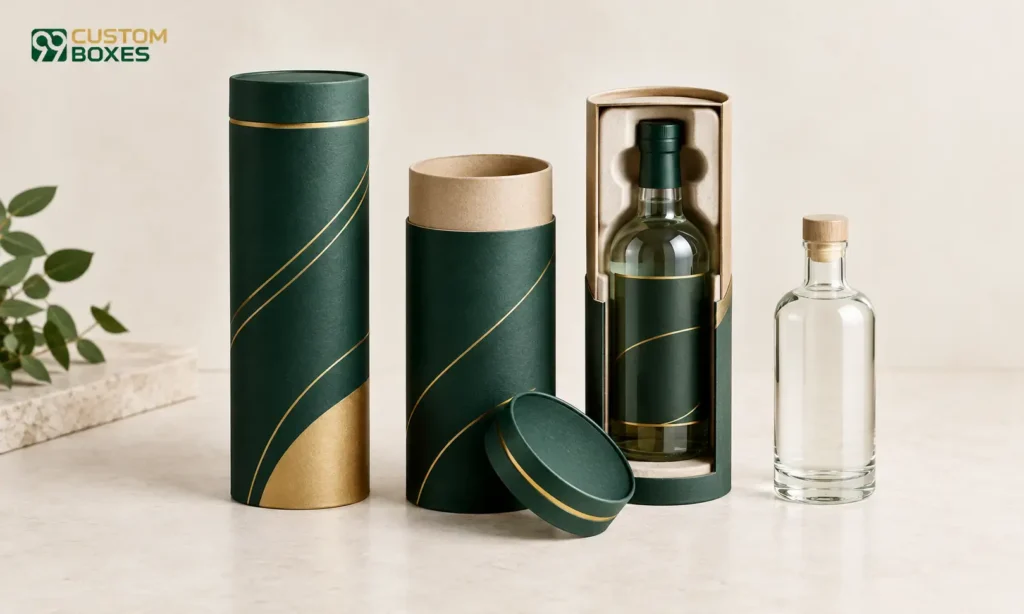
Choosing custom tubes for bottles involves more than finding a cardboard cylinder that looks right. The packaging must accommodate the bottle’s height, widest point, neck and cap, while leaving enough usable space for the closure and any internal support. Material, printing and finishing also need to suit the product’s intended use.
For UK businesses, the best starting point is to measure the actual bottle, decide how it will be held inside the tube, and then select a suitable design. This approach helps you avoid poor fit, unnecessary packaging space, and artwork changes after approval.
Whether you are packaging a spirits bottle, fragrance, skincare product or gift item, this guide explains what to consider before ordering custom bottle tube packaging from 99 Custom Boxes.
1. Start by Measuring the Bottle Correctly
Accurate measurements are the foundation of a well-fitting tube. A bottle may have a narrow base but a wider shoulder, or a cap that adds several centimetres to its overall height. Measuring only the main body can therefore lead to an unsuitable design.
Before requesting a quotation, measure the bottle in the condition in which it will actually be packed.
Measure the overall height
Measure from the bottom of the bottle to the highest point, including its cap, cork, pump or other fitted closure.
If the bottle will have a protective sleeve or another component inside the tube, account for that as well. The final packaged height matters more than the bottle’s height without its accessories.
Measure the widest point
Measure across the widest part of the bottle. Depending on the design, this might be the body, shoulder, or another protruding section.
For an unusual bottle shape, record more than one width measurement and provide a photograph or drawing with the dimensions.
Check the neck and cap
The neck and cap can affect how easily the bottle enters and leaves the packaging. A decorative stopper, spray head, or wide cap may need additional clearance even when the main bottle body fits comfortably.
Do not assume that two bottles with the same body diameter will require identical tubes.
Record labels and protective components
Consider whether the label, decorative sleeve or other external feature could catch against the tube or insert. If the bottle needs additional protective wrapping, measure it with that wrapping in place.
Keep a simple record of the bottle’s height, widest diameter, neck and cap dimensions, weight and preferred orientation. These details give the packaging supplier a clearer starting point.
2. Understand Internal Diameter, Clearance and Usable Height
When specifying cardboard tubes for bottles, internal dimensions are particularly important. External measurements alone do not tell you how much usable room remains once the tube wall, closure, and inserts are considered.
Internal diameter is the width available inside the cylindrical tube. It needs to accommodate the widest relevant part of the packaged bottle, together with any insert and the clearance required for practical packing and removal.
Usable internal height is the space available for the bottle after accounting for the tube’s construction, closure arrangement, and internal supports.
A bottle that fits the diameter but sits too close to the lid may still be unsuitable. Similarly, a tube that leaves excessive space around the bottle may allow unwanted movement.
The aim is to balance three requirements:
- Enough room to insert and remove the bottle without forcing it.
- Appropriate internal support for the bottle’s shape and intended handling.
- A practical finished size without unnecessary space.
The exact allowance depends on the bottle geometry, material construction, closure, and insert. Avoid applying one universal clearance measurement to every bottle.
For a straightforward bottle, measurements from the actual product may be sufficient to begin planning. For an unusual or high-value item, a physical sample can help confirm the fit before approving a full order.
3. Choose Inserts That Suit the Bottle
An insert is an internal component designed to position or support a product within its outer packaging. For bottle tubes, the right arrangement depends on the bottle’s shape, weight, fragility, and intended use.
Possible approaches in bottle packaging include shaped card supports, base pads, foam supports, or neck holders. These are examples of insert types to discuss with your supplier, not a guarantee that every option is available or suitable for every tube construction.
Base supports
A base support can help position a bottle at the bottom of the packaging. Its shape and height need to work with the bottle’s base and the available internal space.
Neck supports
A neck holder may be worth considering when the bottle has a suitable neck geometry and needs additional positioning. Its suitability depends on the shape of the neck and the complete packaging design.
Foam or shaped supports
A shaped support can be designed around particular contours. Before selecting one, consider how the bottle will be inserted, removed, and held in place.
The choice of insert should also reflect the product’s presentation. A fitted internal component may help keep a bottle upright and create a more organised opening experience.
However, an insert should not be assumed to provide tested shipping protection simply because it fits the product. For fragile glass bottles, the complete packaging system needs to be appropriate for the expected handling and transport conditions.
Before ordering, confirm the available insert options, material, dimensions and suitability for your particular bottle.
4. Compare Tube Closures Before Finalising the Design
The closure affects the opening experience, the finished proportions and the space available inside the packaging. It should be considered alongside the bottle measurements rather than added after the dimensions have already been approved.
Depending on the proposed construction, tube packaging may use different lid or end-closure arrangements. The availability of a particular style should be confirmed during quotation.
Separate lid designs
A tube with a separate lid can create a straightforward opening experience. The lid must fit the tube correctly without interfering with the bottle or its insert.
Telescopic constructions
A telescopic design uses sections that slide over one another. The overlap between those sections must be included when calculating usable internal space and finished height.
Other closure arrangements
Alternative end closures may suit particular product and presentation requirements. The relevant considerations include how securely the components fit, how easily the customer can open the tube, and how the construction affects the overall appearance.
When comparing closures, ask:
- How does the closure affect the usable internal height?
- Will the bottle be easy to remove?
- Does the lid arrangement work with the insert?
- Where will the lid meet the printed body?
- Is the proposed construction suitable for the intended handling conditions?
A visually attractive closure is only a good choice if the finished packaging remains practical.
5. Select the Right Material and Wall Construction
The material affects the tube’s appearance, rigidity, weight and suitability for its intended purpose. The best choice depends on the bottle, the required presentation and how the package will be handled.
99 Custom Boxes lists materials including kraft, E-flute corrugated board, Bux board, cardstock, uncoated Super White cardboard and rigid stock for its custom tube packaging range. The suitability of each option for a particular bottle tube should be confirmed against the proposed construction.
Kraft and paper-based materials
Kraft can suit brands seeking a natural-looking presentation. The final appearance depends on the material, print design, and selected finish.
Smoother printing surfaces
Where detailed graphics and particular brand colours matter, discuss the available surface and printing method before choosing a material. The appearance of printed colours can vary with the substrate and finish.
Rigid constructions
Rigid stock may be appropriate when a firmer, more substantial presentation is important. The final specification still needs to account for the bottle’s weight and the conditions in which the package will be used.
Corrugated constructions
Corrugated board may be considered for certain packaging applications where the construction and handling requirements make it appropriate. Its suitability for a particular cylindrical bottle package should be confirmed rather than assumed.
Wall construction also matters. A stronger-feeling tube is not automatically sufficient for every shipping situation. The required specification should be based on the complete packaging design, bottle weight and expected distribution conditions.
6. Plan Printing and Finishes for a Curved Surface
Custom printed cardboard tubes provide space for brand identity, product names, illustrations and other relevant information. However, the curved surface creates design considerations that do not arise in exactly the same way on a flat box.
A logo may wrap towards the side of the tube, small text may become difficult to read at an angle, and a closure can interrupt the visual flow of the artwork.
Start by deciding what the customer should notice first. Keep essential information easy to locate and allow the design to work with the shape rather than treating the tube as a flat rectangle.
Printing choices
99 Custom Boxes lists printing options including CMYK, PMS/Pantone and spot colours, alongside offset and screen printing methods. The appropriate option depends on the artwork, design requirements and confirmed production specification.
CMYK can be suitable for full-colour graphics. Pantone colours may be relevant where a particular brand colour needs closer specification. Ask the supplier to confirm the available method and achievable colour requirements for your chosen material.
Finishing options
Listed finishes include matte and gloss lamination, soft-touch finishes, Spot UV, foil stamping, embossing and debossing. Availability and suitability depend on the selected construction.
A restrained design might use a matte surface with a foil logo, while another brand may prefer a more colourful printed layout. Neither approach is universally better. Choose finishes that support the brand and the practical requirements of the packaging.
Approve the artwork carefully
Before production, check the supplied template and proof for:
- Logo position and readability.
- Text, colour and image placement.
- The seam or join in the printed surface.
- Lid and body alignment.
- Any small text or essential product information.
- The placement of decorative finishes.
99 Custom Boxes lists a free packaging template, flat views and 3D mock-ups among its proofing options. These can help you review the proposed artwork before approval.
7. When Is a Tube Better Than a Conventional Bottle Box?
Custom tube packaging and conventional bottle boxes solve related but different packaging problems. The right format depends on the bottle, the presentation you want and the way the product will be stored, packed, or delivered.
A tube may be worth considering when the cylindrical shape suits the product presentation and a distinctive opening experience is desirable.
A conventional box may be more practical when you need a rectangular footprint, want to pack multiple bottles together or require a layout that makes better use of flat panels.
For bottle shipments, the decision should also account for how the complete package will be handled. Neither a tube nor a box should be assumed to provide adequate protection without considering the material, fit, inserts, and distribution conditions.
For alternative structures, explore Custom bottle boxes and Custom mailer boxes with inserts.
8. What Affects the Cost of Custom Bottle Tube Packaging?
There is no single price that applies to every custom tube. The quotation depends on the finished specification and quantity.
Important factors include:
- Tube dimensions: Height and diameter affect material use and construction.
- Material and wall construction: The selected stock and structure influence the finished package.
- Quantity: The number of units requested affects the production specification and quoted price.
- Closure: Different constructions may require different components and production processes.
- Inserts: Additional internal components affect the overall design and materials.
- Printing: Artwork coverage, colour requirements and print method influence the specification.
- Finishes: Foil, lamination, Spot UV, embossing and debossing may affect production requirements.
- Sampling and delivery: Any sample requirements and delivery arrangements should be included when comparing quotations.
The current Custom Tube Packaging product page lists quantities starting from 100 units. Confirm the minimum for your final specification when Requesting a quote.
For a useful quotation, provide the same dimensions, quantity, materials, printing, and finishing requirements whenever you compare different proposed designs.
9. Prepare Your Bottle Tube Specification Before Ordering
A clear specification makes it easier to assess whether the proposed packaging suits your requirements.
Before contacting a supplier, prepare the following information:
- Bottle details: Height, widest diameter, neck and cap dimensions, weight and shape.
- Quantity: The number of tubes required for your initial order.
- Packaging dimensions: Preferred or required internal diameter and usable height, subject to confirmation.
- Insert requirements: Whether the bottle needs internal positioning or other support.
- Closure preference: The opening arrangement you would like to explore.
- Material: Your preferred appearance and any known handling requirements.
- Artwork: Logo, graphics, colour references, and essential product information.
- Finishes: Any preference for matte, gloss, foil, or other listed finishes.
- Sampling: Whether a physical sample would help confirm fit or appearance.
- Deadline: Your required delivery date and any milestones that affect approval.
If possible, share photographs or a drawing of the actual bottle. For unusual shapes, a physical product sample may help the supplier understand the fit requirements more clearly.
Confirm the final dimensions, construction, available inserts and closures, sampling charges and production timeline before approving the order.
Request a Quote for Custom Tubes for Bottles
The right bottle tube begins with an accurate specification. Bottle dimensions, closure construction, internal support, material, and printing need to work together, not be treated as separate decisions.
99 Custom Boxes offers custom tube packaging with tailored dimensions, listed material and printing options, finishing choices, and design-proofing support. The most suitable specification depends on the bottle and the intended packaging application.
Visit the Custom Tube Packaging page to request a quotation. Share your bottle dimensions, order quantity, and design requirements so the proposed packaging can be assessed against your needs.
Frequently Asked Questions
1. How do I measure a bottle for custom tube packaging?
Measure the complete height, the widest part of the bottle, the neck and the cap. Record the bottle’s weight and include any sleeve or protective component that will remain on it during packing. The final tube dimensions should also account for the closure and any insert.
2. Can custom tubes be made to different bottle sizes?
The Custom Tube Packaging range lists custom and standard sizes. The finished dimensions should be confirmed against the actual bottle and the selected tube construction before production.
3. Can bottle tubes include internal inserts?
Internal support may be relevant for bottles that need to remain positioned inside the tube. Discuss the available insert materials and constructions with the supplier, as suitability depends on the bottle’s shape and the proposed packaging design.
4. Are custom bottle tubes suitable for shipping glass bottles?
Suitability depends on the complete design, including the tube construction, bottle fit, internal support and delivery conditions. Do not assume that a presentation tube alone provides sufficient transit protection. Confirm the specification for the intended shipping use.
5. Can I print my branding on custom tubes for bottles?
The current product page lists printing options including CMYK, PMS/Pantone and spot colours, with various finishes. Confirm which printing method and finishes are appropriate for your selected construction and artwork.
6. What is the minimum order quantity?
The Custom Tube Packaging page currently lists quantities starting from 100 units. Confirm the applicable minimum for your exact bottle tube specification when requesting a quotation.
7. Can I request a physical sample before placing an order?
Physical sampling is listed as available on request and may involve an additional charge. Confirm sample availability, cost and timing before committing to a full production order.
8. How do I get an accurate quotation?
Provide the bottle dimensions and weight, required quantity, preferred tube construction, insert requirements, printing, finishes and delivery deadline. Include artwork or a bottle photograph where available, and ask for confirmation of the finished specification before approval.