
 United States
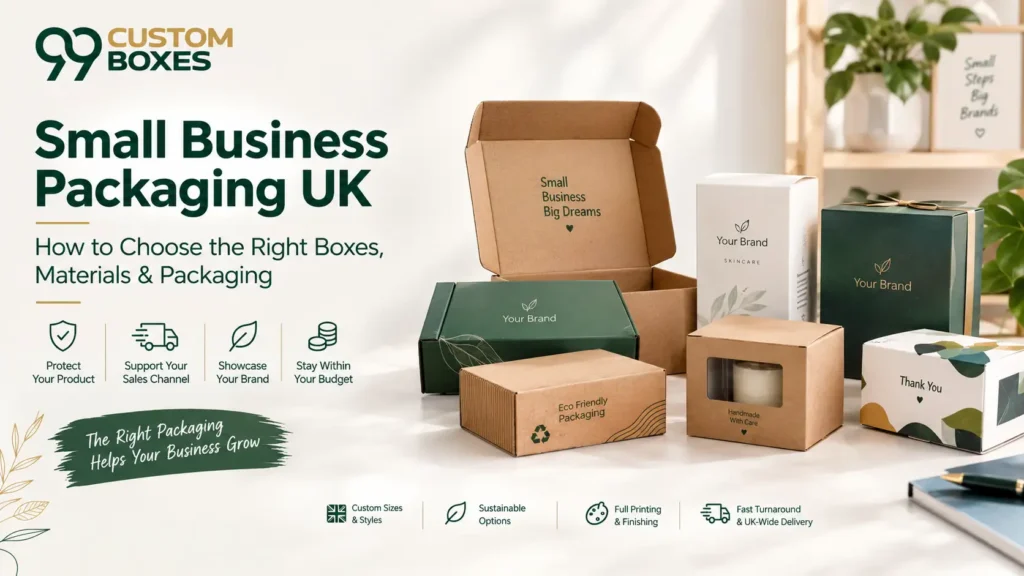
For a small business, packaging has to do several jobs at once. It needs to protect the product, fit your selling channel, make packing straightforward, support your brand, and stay within a realistic budget.
The right choice is rarely just “the cheapest box”. A good packaging specification starts with the product and how it reaches the customer, then works backwards to the box style, material, size and finish.
For most small UK businesses, a practical decision process is:
Product → selling channel → protection needed → box style → material → size → branding → quantity.
99 Custom Boxes offers custom sizes, packaging materials, printing, and finishing options across several box formats, so you can make decisions around the product rather than forcing the product into a standard package.
What Is The Best Packaging For A Small Business?
There is no single best packaging type for every small business. The appropriate option depends mainly on what you sell and how customers receive it.
| Your situation | Packaging to consider | Why |
| You mainly ship ecommerce orders | Mailer boxes or corrugated packaging | Practical for despatch and product protection |
| You sell through shops | Retail boxes, folding cartons or display packaging | Designed around shelf presentation |
| You sell premium gifts | Rigid or gift boxes | Creates a more substantial presentation |
| You sell lightweight handmade products | Kraft or folding cardboard boxes | Simple, brandable and suitable for many products |
| Your products are fragile | Corrugated packaging with inserts | Gives you more scope for protection |
| You sell sets or product bundles | Tray and sleeve or insert-based packaging | Keeps several components organised |
| You need the product visible on shelf | Display or window packaging | Helps present the product without opening the box |
The important point is to choose packaging around the job it needs to perform. A small candle brand shipping orders has different requirements from a jewellery business selling gift sets through independent retailers.
Start With How Your Products Are Sold
Before choosing board, printing or finishes, decide where the packaging will be used.
Ecommerce and online sellers
For online orders, the box has to work through a handling and delivery process before the customer sees it.
A custom mailer box can be useful when you want a combination of product protection, presentation and straightforward packing. 99 Custom Boxes lists custom sizing, board, print, colour, finishes and insert options for its mailer packaging.
For products that need additional protection, corrugated construction can provide a more suitable starting point than a lightweight retail carton.
The key questions are:
- Will the product move around inside the box?
- Does the product need cushioning or an insert?
- Will the box be packed manually in small batches?
- Does it need to fit through a particular shipping process?
- How much storage space do you have for empty boxes?
Retail and independent shops
Retail packaging has a second job: presenting the product.
A retail box may need space for your logo, product information, colour scheme, barcode or other customer-facing details. A window or display structure may also make sense where seeing the product is part of the buying decision.
99 Custom Boxes offers retail packaging in custom sizes with options including kraft, corrugated, rigid and folding board formats, together with printing, finishes, windows and inserts.
Gifting and premium products
For jewellery, premium accessories, gift sets and other products where presentation carries significant value, a rigid or gift-style construction may be more appropriate.
The reason is not simply that rigid packaging “looks expensive”. Its construction can create a different opening experience and provide a stronger platform for premium finishes or fitted inserts.
The 99 Custom Boxes gift-box range includes rigid and foldable styles, multiple paper stocks, custom sizing and finishes such as foiling, embossing and lamination.
Markets, pop-ups and product launches
A small business selling at markets or testing a new product may have different priorities again.
You may need packaging that:
- stores efficiently before the event
- is easy for staff to assemble or pack
- presents the product clearly
- does not lock up too much cash in slow-moving stock
- can be reordered if the launch performs well
This is one reason packaging decisions should be separated from assumptions about order quantity. The right box and the right number of boxes are two different decisions.
Choosing The Right Box Style
The structure of the box affects protection, presentation, storage and packing time.
1. Mailer boxes
Mailer boxes are commonly suited to products that need to be packed, closed and sent directly to the customer.
They make sense when ecommerce fulfilment is a major part of the business and you want the packaging itself to form part of the unboxing experience.
Consider a mailer when:
- the product is shipped individually
- presentation matters after delivery
- you want a branded exterior or interior
- the packaging needs to be designed around a specific product size
2. Shipping and corrugated boxes
Corrugated packaging becomes more relevant when protection during transport is a primary concern.
Rather than selecting the heaviest available board automatically, consider the product’s weight, dimensions, fragility, and how much movement needs to be controlled inside the package.
For fragile products, the box may be only one part of the solution. An insert, divider or other internal component can be just as important.
3. Retail and folding cartons
Folding cartons are often appropriate for lightweight products sold individually or in retail environments.
They can provide a large printable surface without the construction and material requirements of a rigid box.
They are worth considering for products such as:
- cosmetics
- soaps
- candles
- accessories
- small gifts
- packaged retail products
99 Custom Boxes lists folding-board formats alongside kraft, corrugated and rigid options for retail packaging.
4. Rigid boxes
Rigid boxes are constructed to give the package a more substantial, structured feel.
They can suit premium products, gift packaging and products where presentation is an important part of the perceived value.
A rigid box can also be combined with features such as foil, embossing or a magnetic closure. Those additions should be treated as design choices rather than automatic requirements.
5. Tray and sleeve boxes
Tray and sleeve packaging creates a two-part presentation: the inner tray holds the product while the outer sleeve provides the branded cover.
This can work particularly well for premium products, gift sets, and products where you want a deliberate opening sequence without using a conventional rigid lid-and-base box.
99 Custom Boxes offers tray and sleeve structures with custom dimensions, materials, printing and finishing options.
Explore Custom Tray & Sleeve Boxes
6. Display and window boxes
Display packaging is useful when product visibility is important.
A window, cut-out or display structure can allow customers to see the product while keeping it packaged. These formats can be particularly relevant for retail counters, shelves, gifts and products where appearance influences the purchase.
99 Custom Boxes lists options including window, display, and hanging styles, with materials ranging from coated and recycled card to kraft, corrugated, and rigid stock.
Choosing The Right Packaging Material
The material should follow the job the packaging has to do, not simply the look you want.
99 Custom Boxes currently lists options including kraft, E-flute corrugated, Bux Board, cardstock, uncoated white cardboard and rigid stock across its packaging ranges.
Kraft packaging
Kraft board is often considered when a business wants a natural-looking presentation or a simpler packaging aesthetic.
It can suit handmade goods, candles, soaps, food-related products and brands built around a natural or understated visual identity.
The important question is whether the chosen kraft construction also provides the protection the product requires.
Explore Custom Kraft Packaging
Corrugated cardboard
Corrugated cardboard is particularly relevant when transport protection matters.
For an ecommerce seller, the practical specification may involve more than the outer box. Product movement, inserts, and internal cushioning can all affect whether an order arrives in good condition.
For fragile or heavier products, discuss the box structure and internal protection together rather than specifying them separately.
Cardstock and folding board
Card-based packaging can be a practical choice for lightweight products where presentation and print quality are important but heavy-duty shipping protection is not the main requirement.
It is often worth considering when the packaging will sit on a shelf, be handed directly to the customer, or be placed inside another shipping package.
Rigid stock
Rigid stock is more appropriate where the construction and feel of the box are part of the product presentation.
It can be paired with premium finishing options, but a rigid box should not be selected solely because it looks impressive. For a low-value product with simple shipping requirements, the additional construction may not solve a problem that needs solving.
Match The Box To The Product
The same packaging format does not work equally well for every product.
Cosmetics and beauty products
Cosmetics often need retail presentation, clear branding and a neat internal fit. Folding cartons, retail boxes, window structures and inserts can all be relevant depending on the product.
Candles and handmade products
Candles and handmade goods often sit between ecommerce protection and gift presentation.
A kraft box may suit a natural brand identity, while an insert can help keep the product centred during transport. A more premium gift format can make sense where gifting is a major part of the sale.
Jewellery and premium accessories
For small, high-value products, the package can become part of the presentation.
A rigid box or tray-and-sleeve structure may be suitable where protection, presentation and the opening experience all matter.
Clothing and accessories
Packaging requirements vary significantly depending on the product.
Folded clothing may need little internal protection but benefits from efficient dimensions and clear branding. Smaller accessories may need inserts or compartments to stop components moving around.
Fragile products
Fragile products need the packaging specification to consider the whole system:
outer box + internal fit + insert/cushioning + product dimensions.
Simply making the outer box larger is not necessarily an effective protection strategy because extra space can allow movement.
Get The Box Size Right
One of the most useful packaging decisions for a small business is also one of the easiest to overlook: measure the product before choosing the box.
99 Custom Boxes specifies box dimensions using length, width, and height and offers custom and standard sizes across its packaging ranges.
Start by measuring:
- Product length
- Product width
- Product height
- Product weight
- Any protective wrap or insert required
- Whether multiple products will share the same box
Do not design a box around an idealised product photograph. Measure the actual item, including components that will be inside the final package.
A useful packaging brief should therefore specify whether dimensions are being discussed as internal usable dimensions or external finished dimensions.
That distinction can prevent avoidable sizing problems.
How To Control Small Business Packaging Costs
Packaging cost is influenced by several variables rather than one universal price. Size, material, quantity, printing, structure, finishing, and additional components all affect a quotation.
For a small business, five decisions can have a particularly practical effect.
1. Avoid unnecessary box volume
An oversized box can use more material and leave more space around the product.
Use the smallest practical specification that still allows the product to be packed and protected correctly.
2. Do not over-specify the board
Heavier or more substantial material can be useful where protection requires it. It is not automatically better for every product.
Ask what the packaging needs to withstand and specify accordingly.
3. Use finishes selectively
Foil, embossing, debossing, spot UV and premium laminations can create distinctive packaging, but they also add production requirements. 99 Custom Boxes lists these and other finishing options across its packaging ranges.
A restrained finish can often communicate a stronger brand identity than adding several effects at once.
4. Order according to demand
A lower unit price does not automatically mean a lower overall cost for a small business.
If you are still testing the product, changing the branding or refining the packaging, buying a very large quantity can leave cash tied up in packaging that you cannot use.
99 Custom Boxes’ low-MOQ guidance recommends considering sales demand, expected growth, storage space, cash flow, and the likelihood of changing the packaging specification before deciding how much to order.
Read the Low MOQ Custom Packaging Guide
5. Compare like-for-like quotations
When comparing packaging suppliers, use the same:
- dimensions
- box structure
- material
- quantity
- print coverage
- finishes
- inserts
- delivery requirements
A lower quotation may simply describe a different specification.
For more detail on pricing factors, see the Custom Packaging Cost UK guide.
How To Make Packaging Look Professional Without Overspending
Branded packaging does not have to mean adding every available printing and finishing option.
Start with the basics:
Logo + brand colours + clear typography + consistent information hierarchy.
Then decide whether a feature adds a meaningful benefit.
For example, you might use:
- a single strong logo treatment instead of full-surface finishing
- one brand colour alongside a neutral board
- an internal printed message for ecommerce orders
- a simple insert where it improves presentation or product security
- foil or embossing only on a key brand element
99 Custom Boxes supports printing methods including CMYK, Pantone/PMS and spot colours, along with finishing options such as matte or gloss lamination, UV, embossing, debossing and foiling.
Before committing to a complex design, review the artwork carefully and consider a prototype or physical sample where fit, colour, unusual construction or finishing is important. 99 Custom Boxes’ printing guidance specifically recommends sampling for areas such as fragile products, fitted inserts, luxury packaging and colour-sensitive branding.
Read the Custom Box Printing Guide UK
Sustainable Packaging For Small Businesses In The Uk
“Sustainable packaging” is not simply a material choice. The overall packaging specification matters.
A sensible starting point is to ask:
- Can the box be right-sized?
- Is the material appropriate for the product?
- Are unnecessary layers or components being added?
- Could the design work without a difficult-to-separate combination of materials?
- Does the chosen finish or coating affect end-of-life handling?
- Are inserts genuinely necessary?
For UK businesses, packaging responsibilities can also depend on the business’s role in supplying or importing packaging or packaged goods, as well as its size and circumstances. UK government guidance on Extended Producer Responsibility for packaging was updated in 2026 and sets out obligations for businesses that fall within the scheme.
That means environmental claims and compliance questions should be considered separately. A packaging supplier can help specify materials, but businesses should check their own regulatory responsibilities using current government guidance.
For practical packaging design, starting with a well-fitted cardboard or paper-based structure where appropriate can also help avoid unnecessary material and space. The right solution still depends on the product and packaging system rather than a blanket claim that one material is always the most sustainable choice.
A Simple Small Business Packaging Checklist
Before requesting a quote, have these details ready.
Product
What are you packing?
Record the product dimensions, weight, shape, and any fragile components.
Use
How will customers receive it?
Choose between ecommerce shipping, retail presentation, gifting, events, subscriptions or another route.
Protection
What does the product need to survive?
Decide whether the package needs an insert, divider, cushioning or a stronger outer structure.
Box
Which construction solves the job?
Choose a mailer, retail carton, rigid box, tray and sleeve, display box or another format based on actual use.
Material
What level of strength and presentation do you need?
Consider kraft, cardstock, corrugated board, uncoated cardboard or rigid stock as appropriate.
Branding
What needs to be printed?
Specify logo, colours, artwork, information panels, and whether you need inside printing.
Finish
What is worth adding?
Choose finishes that contribute to the customer experience rather than adding effects for their own sake.
Quantity
How many boxes will you realistically use?
Consider sales volume, storage, available cash, seasonal demand and the likelihood of changing the packaging.
Timing
When do you need the packaging?
Give your supplier the intended launch or delivery date so production requirements can be assessed alongside the specification.
Which 99 Custom Boxes Packaging Should You Consider?
The easiest way to narrow the options is to start with the job your packaging needs to perform.
| Business need | Relevant 99 Custom Boxes option |
| Ecommerce orders | Custom Mailer Boxes |
| Shop and shelf presentation | Custom Retail Boxes |
| Gifts and premium presentation | Custom Gift Boxes |
| Beauty and cosmetics | Custom Cosmetic Boxes |
| Product visibility and displays | Custom Display Boxes |
| Premium sets and presentation | Custom Tray & Sleeve Boxes |
| Premium structured packaging | 2-Piece Rigid Boxes |
The company’s product pages list custom sizing, material choices, printing and finishing options across these formats, allowing a specification to be built around the product and intended use.
Make the Right Packaging Choice for Your Business
For a small UK business, good packaging starts with a simple chain of decisions.
What are you selling?
How is it being delivered or displayed?
What protection does it need?
Which structure fits that job?
Which material provides enough strength and presentation?
What size avoids unnecessary space?
Which branding elements matter?
How many boxes can you realistically use?
Once those questions are answered, requesting a packaging quotation becomes much easier.
99 Custom Boxes provides custom packaging in different styles, sizes, materials, print methods and finishes, with quote, design and sampling options available across its packaging range.
For a new product, product launch or packaging refresh, start with accurate dimensions and your expected quantity, then request a quotation based on the actual specification rather than comparing generic box prices.
Frequently Asked Questions
1. What is the best packaging for a small business?
The best packaging depends on your product and how you sell it. Mailer boxes are often suitable for ecommerce orders, retail boxes work well for shop shelves, rigid or gift boxes suit premium products, and corrugated packaging is useful where additional protection is needed. The right choice should balance product protection, presentation, storage, and cost.
2. How do I choose the right box size for my small business?
Measure the product’s length, width, and height, then allow enough room for any insert or protective material. Avoid making the box significantly larger than necessary, as excess space can increase material use and allow the product to move during delivery. For custom packaging, make sure you confirm whether quoted dimensions are internal or external.
3. Is custom packaging worth it for a small business?
Custom packaging can be worthwhile when you need a precise product fit, stronger brand presentation, or packaging designed specifically for ecommerce, retail, or gifting. It can also help you avoid compromising with a standard box size. The value depends on your product, order volume, packaging requirements, and budget.
4. What packaging materials are best for small businesses?
Common options include kraft, corrugated cardboard, cardstock, uncoated cardboard and rigid stock. Kraft can suit a natural or handmade aesthetic, corrugated packaging is useful where protection is important, folding board works well for many lightweight retail products, and rigid stock is suited to more premium presentation. The material should be chosen according to the product rather than appearance alone.
5. What is the difference between mailer boxes and shipping boxes?
Mailer boxes are designed with the packing and delivery experience in mind and can combine protection with branded presentation. Shipping boxes are generally selected primarily around transport protection and may be paired with internal packaging such as inserts or cushioning. Which one is appropriate depends on the product, shipping method, and presentation requirements.
6. How can a small business keep custom packaging costs down?
Start with the correct box size, avoid unnecessarily heavy materials, and use printing and finishes selectively. Order quantities should also reflect realistic demand, storage capacity, and cash flow rather than simply chasing the lowest possible unit price. Comparing suppliers using the same box specification is important when evaluating quotations.
7. Is sustainable packaging suitable for small businesses in the UK?
Yes, but sustainability should be considered as part of the complete packaging specification. Right-sizing the box, avoiding unnecessary components, and choosing appropriate paper- or board-based materials can all be useful considerations. Businesses should also check any packaging-related legal or EPR responsibilities that apply to their specific circumstances.