
 United States
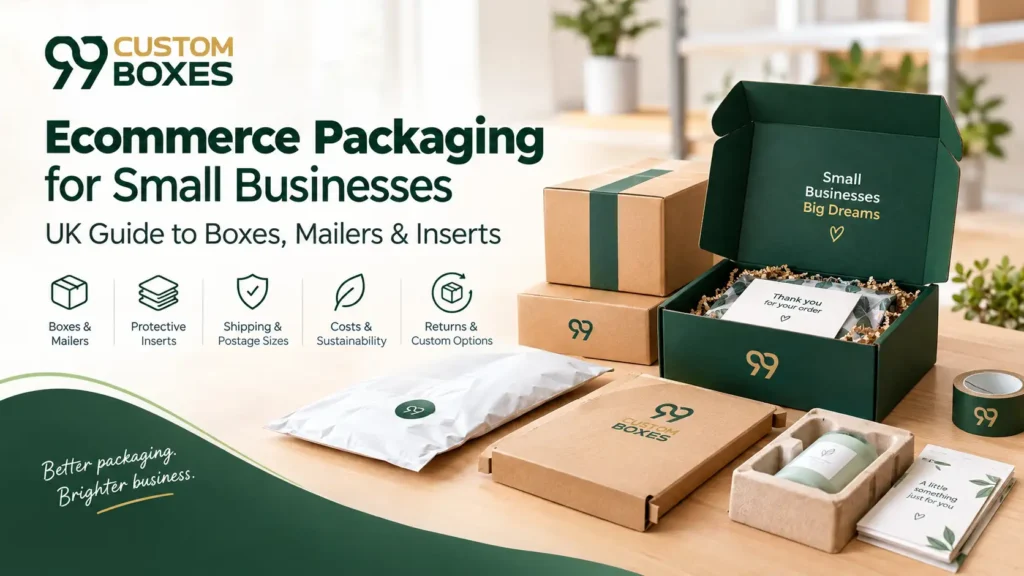
For a small ecommerce business, packaging has to do more than get an order from your packing bench to a customer. The wrong box can waste space, increase protective material, slow down fulfilment, or leave a product vulnerable to damage. The right packaging should fit the product, suit the delivery method, protect the contents, and make sense for your budget.
There is no single best ecommerce packaging option for every business. A clothing seller may need a lightweight mailer, while a candle brand may need a stronger box and an internal insert. A subscription business may prioritise fast assembly and presentation, while a business selling fragile products may put protection first.
For UK online sellers, packaging decisions should therefore start with the product and delivery journey rather than the box design alone.
What Should Ecommerce Packaging Do?
Good ecommerce packaging needs to balance several practical jobs:
- Protect the product during handling and delivery.
- Keep the contents from moving unnecessarily.
- Fit the product without excessive space.
- Work with your chosen postal or courier service.
- Be quick and simple to pack.
- Support a reasonable cost per order.
- Create an appropriate customer experience.
- Make returns easier where your product category requires them.
The Post Office similarly recommends matching packaging to the product, securing items properly, avoiding oversized packaging, and considering packaging costs alongside postage and other fulfilment expenses.
That means the cheapest box price is not necessarily the lowest-cost packaging solution.
How to Choose Packaging for Ecommerce Products
Start with the product rather than choosing a packaging style first.
Before ordering ecommerce packaging, record:
- Product length, width, and height
- Product weight
- Number of items normally included in one order
- Fragility and likely impact points
- Existing product packaging
- Protective material or inserts required
- Final packed dimensions
- How the package will be sealed
- How customers will open it
- Whether customers commonly return the product
This information helps you decide whether a mailer, postal box, shipping carton, mailing bag or another format makes sense.
1. Consider the product’s size and shape
Measure the actual product rather than estimating from photographs or product listings.
For multiple-item orders, measure a typical complete order as well. A box that works perfectly for one item may be too small when customers frequently buy two or three together.
Also distinguish between the inside dimensions needed for the product and the outside dimensions of the finished package. The final parcel dimensions are what matter when you assess how it will move through the delivery network.
Your Small business packaging guide covers the basic measurement process in more detail.
2. Consider fragility
A soft clothing item does not need the same protection as a glass candle, cosmetic bottle or electronic product.
Fragile goods may need:
- Corrugated outer packaging
- Fitted inserts
- Dividers
- Foam or other cushioning
- Paper-based void fill
- Corner protection
- Surface wrapping
The aim is not to fill the box with as much material as possible. The aim is to control harmful movement and protect vulnerable parts of the product.
3. Consider product value
Higher-value products may need additional protection, discreet outer packaging or a more controlled presentation.
For example, a premium product might use an attractive presentation box inside a protective shipping carton. The two layers perform different jobs: one presents the product while the other is designed around its journey through delivery.
Which Ecommerce Packaging Box Should You Choose?
The right format depends on what you sell, how you ship it, and what the customer expects when it arrives.
Mailer boxes
Mailer boxes are useful when you want shipping protection and presentation in one format. They suit many consumer products, subscription boxes, clothing, cosmetics, gifts, and branded ecommerce orders.
A well-designed mailer can combine:
- A structured outer box
- A built-in closing mechanism
- Branded printing
- Custom dimensions
- Optional inserts
- A more controlled opening experience
Custom Mailer Boxes from 99 Custom Boxes can be specified around your product size, board, print coverage, colours and finishes.
Postal boxes
Postal boxes are useful when compact dimensions, straightforward packing and shipping practicality are the main priorities.
The terms postal box and mailer box are not always used consistently by suppliers, so look beyond the name. Check the actual construction, dimensions, board strength, closure, printing and intended use.
For smaller products, a compact postal-style format can make more sense than putting everything into a larger carton.
Shipping boxes
Shipping boxes are better suited to products that need more transport-focused protection, especially heavier goods, fragile orders, or multiple products packed together.
99 Custom Boxes offers Custom Shipping Boxes with options including corrugated construction, single- or double-wall strength, custom printing, and protective inserts.
Kraft mailers
Kraft packaging can be useful for brands that want a simple, natural-looking presentation while keeping the package practical for shipping.
The important point is not simply whether a material looks sustainable or premium. Check whether its structure provides the protection your product actually needs.
See the Custom Kraft Mailer Boxes available from 99 Custom Boxes.
Mailing bags
Mailing bags can work well for soft, flexible products such as some clothing orders. They take less space than rigid boxes and can simplify packing.
They are less suitable where the product needs crush protection or where the outer package needs to maintain its shape.
Rigid presentation boxes
Rigid boxes can provide a premium presentation, but they should not automatically be treated as the best option for ecommerce shipping.
A luxury presentation box may still need an outer shipping layer if the product could be damaged during transit. The best choice depends on whether the packaging’s main job is presentation, protection, or both.
Mailer Boxes vs Postal Boxes: What Is the Difference?
Rather than choosing based on the label, compare the practical characteristics.
Choose a mailer-style format when:
- Brand presentation matters.
- The customer opening experience is important.
- You want integrated closure features.
- Your products suit a structured box.
- You want custom print or finishes.
A postal-style box may make more sense when:
- Compact shipping is the priority.
- You want straightforward packing.
- Product presentation is less important than postage efficiency.
- The products are relatively simple to pack.
- You need a practical format for regular dispatches.
For some businesses, using both makes sense. For example, a brand could use branded mailer boxes for direct-to-consumer orders and simpler shipping cartons for wholesale or bulk dispatches.
Single-Wall vs Double-Wall Boxes
Corrugated board construction should match the demands placed on the package.
A single-wall box can be suitable for many lightweight or moderately protected ecommerce orders. Double-wall construction adds another layer of fluting and liner material, which can provide greater structural strength.
Single-wall packaging may suit:
- Clothing
- Lightweight packaged products
- Small accessories
- Products that already have protective retail packaging
- General ecommerce orders with relatively low protection demands
Double-wall packaging may be more appropriate for:
- Heavier products
- Fragile goods
- Multiple products packed together
- Orders where stronger compression resistance is needed
- Products that place more stress on the outer carton
More board is not automatically better. Using a stronger box than the product requires can add material and cost without solving a real packaging problem.
Your Custom Shipping Boxes page can be used when comparing single- and double-wall options for a specific shipping requirement.
How to Choose the Right Box Size for Ecommerce
Right-sizing is one of the most important packaging decisions for a small online business.
A useful process is:
Measure the product → account for necessary protection → choose the smallest practical internal space → check the final external dimensions → test the packed parcel.
Avoid choosing one very large box for every product simply because it gives you flexibility. Extra space can require more void fill and can make the parcel larger than necessary.
A better approach for a growing ecommerce business is often to create a small range of box sizes that cover the majority of your orders.
For example, you might have:
- A compact format for single small items
- A medium format for common multi-item orders
- A larger format for bundles or larger products
This can make stock management and packing easier without requiring dozens of box sizes.
Royal Mail Large Letter and Small Parcel Sizes
UK sellers should check the delivery service before finalising box dimensions.
Royal Mail currently lists a Large Letter maximum of 35.3cm × 25cm × 2.5cm, with a maximum weight of 750g. Its Small Parcel maximum is 45cm × 35cm × 16cm, with a maximum weight of 2kg.
These limits are useful when planning packaging because a product that could fit within a particular service’s size and weight requirements may become more expensive or require a different service once the final packed dimensions increase.
Do not design your packaging around an old postage chart. Royal Mail’s services, limits and prices can change, so check the current service information when you are approving a new packaging specification.
Also remember that Royal Mail is only one delivery option. If you use another carrier, check that carrier’s own size, weight and pricing rules.
What Is Dimensional or Volumetric Weight?
Some courier and freight services consider the amount of space a parcel occupies as well as its physical weight.
This is commonly referred to as dimensional weight or volumetric weight.
For example, a lightweight product in a very large carton can take up more vehicle or storage space than its actual weight suggests. Depending on the carrier and service, that can affect the chargeable weight.
This is another reason not to leave large amounts of unnecessary space inside ecommerce packaging.
Before changing box dimensions, check your specific carrier agreement or shipping calculator. Do not assume that every UK delivery service calculates charges in the same way.
Void Fill and Cushioning Materials
Void fill is used to control movement and protect products inside a package.
Common options include:
- Paper cushioning
- Cardboard inserts
- Foam
- Air cushioning
- Other protective materials appropriate to the product
The right solution depends on the product’s fragility, shape, weight, and available space.
A common mistake is to keep adding void fill to a box that is simply too large. If a product rattles around in the package, ask whether changing the box size or adding a fitted insert would solve the problem more efficiently.
The Post Office recommends adding suitable protective material to stop fragile products moving around inside their packaging.
Packaging Inserts for Ecommerce
Inserts can perform several different jobs, so choose them according to the problem you need to solve.
Protective inserts
These hold products in position and reduce movement.
They can be useful for fragile or premium products that need a controlled internal fit. Custom Mailer Boxes with Inserts can be specified around the product and its protective requirements.
Dividers
Dividers separate multiple items inside one package. They can be useful when several products need to remain separated during transport.
Presentation inserts
A presentation insert can help position the product consistently when the customer opens the package.
Information inserts
These may include:
- Care instructions
- Product information
- Usage guidance
- Return instructions
- Thank-you messages
- QR codes leading to useful customer resources
An insert should earn its place. If it does not improve protection, information, usability or customer experience, it may simply increase material and packing costs.
How to Reduce Packaging Costs When Selling Online
Packaging cost is more than the price printed on a supplier quotation.
For planning purposes, think about the total cost of an order as:
Box + protective materials + inserts + sealing materials + packing time + storage impact + shipping impact + potential damage/return costs
Not every business will need to calculate each item separately, but the framework helps explain why the cheapest box is not always the cheapest packaging solution.
Reduce unnecessary size
Large boxes can consume more board and require more void fill. They may also take more storage space and, depending on the shipping service, affect delivery charges.
Reduce unnecessary packaging layers
More wrapping does not automatically mean better protection. Test what the product actually needs.
Review your box range
If you have ten packaging sizes but only use three regularly, you may be tying up storage space in slow-moving stock.
Look at actual order data and identify the packaging formats used most often.
Make packing faster
A packaging design that takes several extra minutes to assemble can become expensive as order volume grows.
Consider:
- How many folds are required?
- Does the box need tape?
- Is the closure easy to use?
- Does the insert fit without adjustment?
- Does the packer need additional protective material?
- Can the shipping label be applied easily?
Packaging suppliers such as RAJAPACK also emphasise the role of boxes, protective materials, sealing equipment and a suitable packing workspace in improving ecommerce fulfilment efficiency.
Compare cost per order, not just cost per box
Suppose a low-cost box requires extra void fill, more tape and additional packing time. A slightly more expensive box with a better fit may provide a lower overall cost per successfully packed order.
That is why packaging should be evaluated as part of the whole fulfilment process.
Packaging Storage Space and Stock Management
Small businesses often focus on how much packaging costs to buy and forget about where it will be stored.
Packaging stock can quickly take over a small workspace if you keep too many sizes, formats and protective materials.
Look for packaging that:
- Can be stored efficiently
- Matches your actual order mix
- Can cover multiple common products
- Does not require excessive protective materials
- Is easy for staff to access
Flat-packed boxes can also help with storage compared with fully assembled rigid packaging.
The goal is not to reduce your packaging range at all costs. It is to keep a range that reflects how your business actually fulfils orders.
Packing Time and Fulfilment Efficiency
Packaging becomes an operational issue as order volume increases.
A good ecommerce pack should be easy to:
- Pick from storage
- Assemble
- Place the product inside
- Add protection or inserts
- Seal
- Label
- Dispatch
If several extra steps are required for every order, the effect grows with volume.
This is particularly important for subscription businesses and ecommerce brands with repeatable orders. A consistent packaging structure can make packing easier to standardise.
Make Ecommerce Packaging Return-Friendly
Returns are often easier when the original packaging can be opened without destroying it.
Return-friendly packaging can include:
- Resealable closures
- A second adhesive strip
- Tear strips
- Durable mailer construction
- Clear return instructions
- Enough structure to survive the return journey
This is especially useful for product categories where returns are common.
The Post Office recommends considering returns when planning business packaging and keeping suitable packaging supplies available.
Think about the second journey before approving your first packaging design.
Sustainable Ecommerce Packaging in the UK
Sustainable packaging is not simply a choice between “eco” and “non-eco”.
Consider the complete package:
- Is the box appropriately sized?
- Is unnecessary material being used?
- Can the packaging be reused?
- Can the main components be recycled through available systems?
- Are coatings or mixed materials making disposal more difficult?
- Are protective inserts actually necessary?
- Could right-sizing reduce excess material?
Using less packaging where practical can be as important as selecting a different material.
The Post Office recommends reducing unnecessary packaging, considering recyclable or reusable options and avoiding excessive extras.
Do not use sustainability claims such as “100% recyclable” unless they accurately apply to the specific packaging specification and disposal route.
Should Small Businesses Use Custom Packaging?
Custom packaging can make sense when standard formats create a specific problem.
Consider custom packaging when you need:
- A better product fit
- More consistent protection
- A particular box structure
- Branded printing
- Specific inserts
- A controlled unboxing experience
- A packaging size designed around a common order
It may be less useful when you are testing a new product with unpredictable demand or when a standard package already performs well.
Quantity matters too. Instead of choosing custom packaging simply because it looks better, compare the likely packaging cost per order and the operational benefits it provides.
99 Custom Boxes offers custom and standard packaging options, with quantities varying by product and specification. Its mailer box range currently shows low-quantity options, while exact minimums should be confirmed for the specific packaging required.
For businesses starting with smaller quantities, the Low MOQ Custom Packaging UK page is a useful next step.
How to Build a Practical Packaging Specification
Before requesting quotes, prepare a short packaging brief.
Include:
Product details
- Product dimensions
- Product weight
- Typical order quantity
- Fragility
- Existing inner packaging
Shipping requirements
- Final packed dimensions
- Target carrier or postage service
- Required protection
- Return requirements
Box requirements
- Mailer or shipping format
- Single-wall or double-wall construction where relevant
- Insert requirements
- Closure preference
Brand requirements
- Logo
- Colours
- Artwork
- Print coverage
- Required finishes
Commercial requirements
- Estimated monthly quantity
- Desired initial order quantity
- Storage limitations
- Target packaging cost
The more complete the brief, the easier it is to compare quotes based on the same specification.
99 Custom Boxes provides Free design support and allows businesses to request packaging specifications and quotes.
Ecommerce Packaging Checklist for Small Businesses
Before approving a packaging format, ask:
- Does the box fit the product properly?
- Is the product protected against likely movement and impact?
- Is the board strength appropriate?
- Does the final parcel fit the intended delivery service?
- Am I using more void fill than necessary?
- Can the package be assembled quickly?
- Can my current workspace store the required stock?
- Is the packaging cost sensible per order?
- Does the packaging match the customer experience I want?
- Can the product be returned using the original packaging?
- Are the sustainability claims accurate?
- Would an insert solve a protection or presentation problem?
- Would a custom size provide a real operational benefit?
Choosing Packaging That Works for Your Business
The best ecommerce packaging for a small UK business is the packaging that solves the actual delivery problem without adding unnecessary cost or complexity.
Start with the product’s dimensions, weight and fragility. Then consider box structure, internal protection, postage limits, packing time, storage, branding and returns. For small businesses, a well-chosen mailer, postal box or shipping carton can often do more than a complicated packaging system because it is easier to stock, pack and repeat.
When standard packaging no longer fits the product or fulfilment process, custom sizing, printing or inserts can provide a more precise solution.
For help comparing packaging sizes, materials, printed finishes and protective options, explore the Custom ecommerce packaging options from 99 Custom Boxes or request a quote based on your product and order requirements.
Frequently Asked Questions
1. What packaging is best for a small ecommerce business in the UK?
The best packaging depends on the product, weight, fragility, size, and delivery method. Mailer boxes work well for many branded ecommerce orders, while shipping boxes are better suited to heavier or more fragile products. Flexible products may work with mailing bags, while products needing extra protection can benefit from inserts or cushioning.
2. How can small businesses reduce ecommerce packaging costs?
Start by choosing the right-sized packaging, reducing unnecessary void fill, using an efficient range of box sizes, and reviewing the total cost per order rather than just the box price. Packing time, storage, protective materials, and shipping charges can all affect the real cost of packaging.
3. Are mailer boxes better than standard shipping boxes for ecommerce?
Neither is universally better. Mailer boxes can combine presentation, branding, and convenient closure, making them suitable for many direct-to-consumer orders. Standard shipping boxes can be more appropriate when strength, flexibility, or transport protection is the main priority.
4. Do ecommerce businesses need packaging inserts?
Not every product needs an insert. Inserts are useful when you need to stop products moving, separate multiple items, protect fragile products, or improve presentation. The right insert can also reduce the need for loose void fill inside the package.
5. How do I choose the right box size for ecommerce orders?
Measure the product, allow enough space for any required protection, and then check the final packed dimensions against your intended delivery service. Avoid oversized boxes because they can increase material use, void fill, storage requirements, and, depending on the carrier, shipping costs.
6. Is custom packaging worth it for a small business?
Custom packaging can be worthwhile when standard boxes do not provide the right fit, protection, presentation, or packing efficiency. It can also help with branded printing, custom inserts, and consistent product presentation. Compare the practical benefits against your order volume and packaging budget before committing.
7. How can ecommerce packaging make returns easier?
Return-friendly packaging can include resealable closures, tear strips, second adhesive strips, and clear return instructions. Designing the package for both the outbound and return journey can reduce the need for customers to find replacement packaging.