
 United States
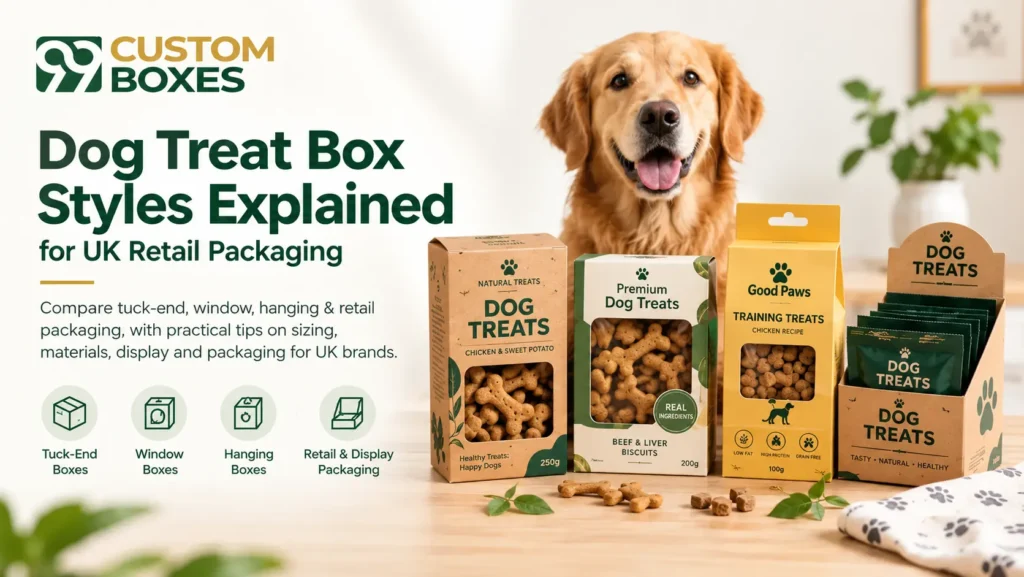
Choosing a dog treat box is about more than printing a logo on cardboard. The right structure needs to suit the shape and weight of the treats, the way customers will buy them, the amount of product information you need to display, and how the pack will be handled before it reaches the customer.
A box designed for dry biscuits sold from a pet shop shelf may have different priorities from packaging used for an ecommerce subscription box. A window may make sense for visually appealing biscuits, while a hanging box can be more practical where products are displayed from hooks. For some brands, a straightforward tuck-end carton may offer the cleanest balance between presentation, practicality and cost.
This guide explains the main Dog treat box styles, what each one is designed to do, and the questions to answer before choosing a structure for the UK market.
How to Choose a Dog Treat Box
Before choosing a box style, look at five things:
- The type of treat
- The size, shape and fill weight
- Where the product will be sold
- How much information needs to fit on the pack
- Whether the box is the primary package or an outer pack
These decisions are connected.
For example, a lightweight box may be perfectly suitable for dry biscuits that are already sealed inside an inner pouch. A different packaging approach may be needed where the treats are more fragile, oily, soft, or sensitive to moisture and oxygen.
It is also useful to decide whether the package needs to work mainly on a retail shelf, on a hanging display, inside an ecommerce parcel, or across several channels.
1. Tuck-End Dog Treat Boxes
Tuck-end boxes are one of the most straightforward structures for dog treat packaging.
The box is typically closed by folding a tuck flap into the opposite panel. Depending on the construction, the tuck can be positioned at one end or at both ends.
Why choose a tuck-end box?
The main advantage is simplicity.
A tuck-end structure can provide a clean front panel for branding while leaving other panels available for product information, feeding instructions, ingredients, and other required details.
This makes the style particularly useful for:
- Dry dog biscuits
- Training treats
- Small baked treats
- Dental sticks
- Chews
- Single-product retail packs
- Multipacks and small treat assortments
The structure can also be produced in different board types and customised to the dimensions of the product rather than forcing the treats into a generic box size.
When a tuck-end box makes sense
A tuck-end design is worth considering when your priorities are straightforward presentation, easy opening and efficient use of printable panels.
For example, a pet bakery selling several biscuit flavours could keep the same basic structure across the range while changing the front artwork, flavour information and colour treatment for each SKU.
That creates a consistent packaging system without making every product structurally different.
What to watch for
Do not choose the box size based only on the number of treats you want to include.
Measure the actual product, then consider:
- Treat dimensions
- Product arrangement
- Fill weight
- Required headspace
- Whether an inner bag or liner is being used
- Whether fragile treats need separation
A box that is too large can allow biscuits to move around during handling and shipping. A box that is too tight can create unnecessary pressure on fragile products.
2. Window Dog Treat Boxes
Window dog treat boxes add a transparent section to the packaging so customers can see part of the product without opening the box.
This can be useful for dog biscuits, decorated treats, colourful chews or products where visual appearance forms part of the buying decision.
A window can also reduce the need for product photography to do all the visual work on a retail shelf because some of the actual product remains visible.
When a window works well
A window can be particularly useful when:
- Treat appearance is important
- The product has distinctive shapes or colours
- You want customers to see the quantity or assortment
- The packaging is intended for retail display
- Product visibility supports the brand concept
For an artisan dog bakery, for example, showing the actual biscuit shape can reinforce the handmade or speciality positioning.
The trade-off with window packaging
A window is not automatically better simply because it increases visibility.
Adding a window changes how you plan the artwork. You have less solid printable area, and the packaging needs to be designed around the cut-out.
Also consider what the customer actually sees through the window.
If the treats are poorly arranged, broken, or covered by an inner pack, the window may add little value.
The strongest window designs treat visibility as part of the overall layout rather than adding a clear panel as an afterthought.
99 Custom Boxes offers custom printed window packaging and window patching as part of its available packaging options. Explore custom printed window boxes
3. Hanging Dog Treat Boxes
Hanging boxes are designed for retail environments where products are displayed from hooks, pegs, or similar fixtures.
A hang-tab or hanging feature can make the product easier to place in areas where a standard shelf carton would be less practical.
This style is particularly relevant to smaller treat packs where the retailer wants to use vertical merchandising space.
Good uses for hanging packaging
Hanging dog treat boxes can work well for:
- Training treats
- Small snack packs
- Dental treats
- Trial or sample sizes
- Impulse-friendly products
- Smaller retail packs
The structure gives the packaging a different job from a conventional shelf carton. It needs not only to contain the product but also to interact with the retail display system.
What to consider before choosing a hanging box
Check where the product will actually be displayed.
A hang-tab is useful only if the intended retailer uses suitable hooks or peg fixtures. For products that will mainly sit on shelves or go directly to ecommerce customers, the extra feature may not provide much practical value.
Also consider the weight distribution of the package. A heavy product requires a structure that can support the load during storage, handling, and display.
4. Retail Dog Treat Boxes
“Retail packaging” is not one single box structure. It is better understood as packaging designed around the retail environment.
A retail-ready dog treat box may use a tuck-end construction, a window, a hanging tab or a display-style format depending on how the product is sold.
The retail objective is to make the pack easy to identify, easy to handle, and informative enough for the customer to understand what they are buying.
What makes a dog treat box retail-ready?
A retail pack often needs clear space for:
- Product name
- Brand identity
- Treat type
- Intended species
- Weight or quantity
- Composition or ingredients information
- Feeding guidance
- Storage information where applicable
- Batch or traceability information
- Business details
- Barcode or other retail information where required
The exact labelling requirements depend on the product and how it is marketed, so the artwork should be checked before the final print file is approved.
For UK pet food, labelling is subject to feed-specific requirements. UK Pet Food states that labels must clearly communicate whether the product is complete or complementary, the species for which it is intended and directions for use, while analytical constituents include crude protein, crude oils and fats, crude fibre, crude ash and moisture where it exceeds 14%.
GOV.UK guidance also notes that additional information on pet food labels must be objective, substantiated and not misleading.
That means packaging design should leave enough space for required information rather than using every available panel purely for promotional artwork.
5. Display-Style Dog Treat Packaging
Some brands need packaging that does more than sit on a shelf.
A display box can combine product containment with a presentation function, making it suitable for counters, promotional displays, multipacks or organised retail arrangements.
Display-style packaging may be useful for:
- Mixed treat collections
- Gift sets
- Seasonal products
- Promotional packs
- Subscription selections
- Counter displays
- Multi-SKU presentations
The advantage is that the structure can be planned around how the customer sees and accesses the product.
99 Custom Boxes offers custom display boxes that can be specified around size, material, print, and additional features such as inserts and window patching. Explore custom display boxes
Dog Treat Box Styles Can Be Combined
One of the most important points when comparing packaging styles is that these features do not always have to be chosen separately.
A box can combine structural and visual features.
For example, a dog treat pack could use:
- A tuck-end structure with a front window
- A hanging box with a product-viewing panel
- A display structure with internal dividers
- A retail box with an insert to separate different treat varieties
This gives brands more flexibility when a single structure needs to satisfy several requirements.
The right combination depends on the product and sales channel rather than on the packaging style alone.
Choosing Dog Treat Packaging Materials
The material affects appearance, structure, print quality, and protection.
99 Custom Boxes lists options including kraft, E-flute corrugated, Bux board, cardstock, uncoated Super White cardboard, and rigid stock for its Pet Treat Boxes. It also offers different printing processes, finishes, window patching, and inserts.
The best material depends on what the packaging needs to do.
Kraft
Kraft can be useful for brands looking for a natural or understated visual direction.
It can suit artisan bakeries, natural-looking product ranges and brands where the texture and colour of the board are part of the design.
However, the choice should still be based on the required construction and print result rather than appearance alone.
Cardstock and carton board
These materials can be suitable for lightweight retail cartons where the product needs a clean printable surface and defined folds.
They work well for many conventional tuck-end and window box applications.
E-flute corrugated board
Corrugated construction provides greater structural protection than a lightweight carton.
It can be worth considering where the package needs additional rigidity or protection, particularly when products are being shipped.
The correct choice still depends on product weight, box dimensions and distribution conditions.
Rigid stock
Rigid packaging is generally associated with a more substantial presentation.
It can be relevant to premium gift sets, special editions or higher-end product presentation, although it may be unnecessary for everyday treat packs where a lighter carton performs the job adequately.
Dog Treat Packaging for Dry vs Soft Treats
Not all dog treats place the same demands on packaging.
This is an area where packaging decisions are often oversimplified.
Dry dog treats
Dry biscuits and baked treats may have different moisture and freshness considerations from softer products.
When the treats are already sealed in an appropriate inner pouch or bag, the outer cardboard box can primarily provide branding, structure, handling protection, and retail presentation.
In this situation, the box does not necessarily need to act as the main oxygen or moisture barrier.
Soft or moist treats
Soft, moist, or oily treats can create different packaging requirements.
Depending on the product formulation and shelf-life target, the inner packaging may need stronger barrier properties than a standard folding carton can provide.
For these products, think about the complete package rather than asking whether the cardboard box itself is “freshness-proof”.
Consider:
- Product moisture
- Oil or fat content
- Oxygen sensitivity
- Expected shelf life
- Inner pouch or liner
- Temperature and storage conditions
- Shipping environment
The box can then be selected around the needs of the product system.
This is also why a dog treat packaging material should not be chosen purely because it looks premium. Performance needs to come first.
How to Package Dog Treats for Sale
A practical packaging process starts with the product, not the artwork.
Step 1: Measure the treats
Record the approximate:
- Length
- Width
- Height
- Number of pieces
- Fill weight
Also note whether the treats are uniform or mixed.
Step 2: Decide whether an inner pack is needed
Ask whether the treats will sit directly inside the box or whether they will first be packed in a pouch, liner, or other inner packaging.
This distinction affects how the outer box should be designed.
Step 3: Identify the sales channel
Think about whether the package will mainly be sold through:
- Independent pet shops
- Larger retailers
- Pet boutiques
- Online stores
- Subscription boxes
- Markets and events
- Direct-to-consumer shipping
The answer can change the preferred structure.
Step 4: Choose the box style
Now compare tuck-end, window, hanging, or display-style options.
The choice should follow the job the packaging needs to perform.
Step 5: Plan the information panels
Before designing the front artwork, make space for regulatory and product information.
This is especially important for UK pet food products.
Step 6: Build and review the dieline
A proper box template or dieline helps confirm the relationship between:
- Panels
- Folds
- Glue areas
- Windows
- Tuck flaps
- Product information
- Barcode placement
- Print areas
99 Custom Boxes offers box templates, flat views, and 3D mock-ups for its Pet Treat Boxes.
Step 7: Sample before scaling production
A physical sample can reveal problems that are difficult to spot on a screen.
Check:
- Product fit
- Opening and closing
- Treat movement
- Window positioning
- Print appearance
- Label space
- Overall shelf presentation
Dog Treat Packaging Design: What Should Go on the Box?
A strong dog treat packaging design needs to balance brand presentation with useful information.
The front panel should normally communicate the product quickly.
A typical hierarchy could be:
Brand → Product type → Key product detail → Net quantity
Other panels can then carry the detailed information required for the product.
Avoid filling every available area with decorative graphics. A crowded pack can make important information harder to find.
For products sold in retail environments, think about what a customer can understand in a few seconds.
Can they tell:
- What the product is?
- Who it is for?
- What type of treats are inside?
- How much they are buying?
- What makes the product different?
The packaging should answer those questions before the reader needs to turn the box around.
Dog Treat Packaging Labels and UK Requirements
The packaging structure and label design need to work together.
UK pet food labels have feed-specific requirements, and businesses should check the current rules that apply to the product before final artwork is printed. UK Pet Food’s current labelling guidance identifies mandatory areas including the product’s complete or complementary status, intended species, feeding directions, analytical constituents and responsible business details.
Other labelling information can include batch or lot references, net quantity and minimum storage life, depending on the product and applicable requirements. Local authority guidance also highlights these elements for prepacked pet food.
There is another important point: claims on packaging need care.
GOV.UK states that additional information on pet food labels must be objective, quantifiable where applicable, and capable of being substantiated, and must not mislead purchasers or make medicinal claims.
For that reason, review your copy before sending final artwork to print.
This section is general packaging information, not legal advice. For a product-specific compliance decision, check the latest UK requirements or obtain appropriate regulatory advice before printing.
Dog Treat Packaging for Retail vs Ecommerce
The best box for retail may not be the best box for ecommerce.
Retail packaging
Retail packaging often prioritises:
- Shelf visibility
- Product recognition
- Clear information
- Consistent branding
- Easy handling
- Display compatibility
A window or hanging feature may be especially useful depending on the store format.
Ecommerce packaging
Ecommerce packaging needs to consider:
- Product movement
- Compression
- Courier handling
- Outer shipping protection
- Box dimensions
- Presentation after delivery
A retail carton may need a separate outer mailer for ecommerce distribution.
For brands selling subscription boxes, a custom mailer can also be useful when the packaging itself is intended to become part of the delivery experience.
99 Custom Boxes offers custom mailer boxes and mailer boxes with inserts for ecommerce applications. Explore custom mailer boxes
Explore mailer boxes with inserts
Common Dog Treat Packaging Mistakes
Choosing the box before measuring the product
The artwork may look excellent, but an incorrect internal size can lead to movement, crushing, or wasted space.
Treating the outer box as the only barrier
A cardboard carton is not automatically the main freshness barrier for every dog treat. Consider the whole packaging system.
Making the front panel too busy
Important information can become difficult to identify when branding, illustrations, claims, and product details compete for attention.
Adding a window without considering the product inside
A window is only useful when the product visible through it contributes positively to the presentation.
Ignoring the sales channel
Packaging designed for a shelf, a peg display and an ecommerce parcel may have different structural priorities.
Leaving regulatory information until the end
Required information needs planned space. Adding it after the visual design is finished can create awkward layouts or force a redesign.
Custom Dog Treat Boxes from 99 Custom Boxes
99 Custom Boxes offers custom Pet Treat Boxes for dog biscuits, chews, dental sticks, and other small pet snacks.
The available options include custom and standard sizes, kraft, E-flute corrugated, Bux board, cardstock, uncoated Super White cardboard, and rigid stock. Packaging can also be produced with CMYK, PMS/Pantone, spot-colour, offset or screen printing, along with finishes such as matte, gloss, soft-touch, UV, embossing, debossing and foiling. Window patching and custom inserts or dividers are also available.
The current product information lists quantities from 100 to 500,000 boxes, along with box templates, 3D mock-ups, design support, and physical sampling on request.
For brands deciding between tuck-end, window, hanging, or display-style packaging, the practical starting point is to provide the product dimensions, expected quantity, and intended use.
From there, the box can be planned around the product rather than selecting a generic structure first.
Which Dog Treat Box Style Should You Choose?
There is no single best packaging for dog treats in every situation.
A useful way to narrow the choice is:
Choose tuck-end when you want a straightforward, versatile retail carton with good printable panels.
Choose a window box when product visibility is an important part of the presentation.
Choose a hanging style when the product is intended for peg or hook-based retail displays.
Choose a display-style box when the packaging needs to support counters, multipacks, promotional layouts, or stronger merchandising.
Then consider material, internal fit, labelling space, and whether an inner pouch or liner is required.
The most effective custom dog treat box packaging is not necessarily the most elaborate design. It is the structure that fits the product, supports the sales channel, and leaves enough room for clear, accurate information.
Frequently Asked Questions
1. What type of box is best for dog treats?
It depends on the product and where it will be sold. Tuck-end boxes are versatile for many dry treats, window boxes are useful when product visibility matters, hanging boxes suit peg displays, and display-style packaging can work for multipacks or promotional retail presentations.
2. Are window dog treat boxes suitable for retail?
Yes, a window can be useful for retail products where seeing the actual treats adds value. The window should be planned around the artwork, product arrangement and packaging requirements rather than treated as a decorative feature.
3. What materials are used for dog treat packaging boxes?
Common options include kraft, cardstock, Bux board, E-flute corrugated, uncoated Super White cardboard, and rigid stock. The most suitable material depends on the size, weight, structure, and distribution requirements of the product.
4. Do dog treat boxes need food-contact materials?
That depends on how the product is packed. If the treats will directly contact the box material, confirm that the selected packaging is suitable for the intended use. When the treats are contained inside an inner pouch or liner, the packaging system should be assessed as a whole.
5. What information should be on UK dog treat packaging?
UK pet food labelling has specific requirements covering matters such as the type of feed, intended species, feeding directions, analytical constituents and responsible business details. Other information, including batch references, net quantity and storage-life details, can also apply depending on the product. Always check the current rules before final artwork is approved.
6. Can dog treat boxes be made in custom sizes?
Yes. Custom sizing is useful when standard dimensions result in too much space or do not fit the treats correctly. 99 Custom Boxes lists both custom and standard sizes for its Pet Treat Boxes.
7. Can I combine a window with a tuck-end or hanging box?
Yes. Packaging structures and features can be combined where the design supports the intended use. For example, a tuck-end carton can incorporate a window, while a retail hanging format can also include a viewing panel.
8. Can dog treat packaging be used for ecommerce?
It can, but the box should be evaluated for the shipping environment. Some brands use the retail box as the inner package and add an outer mailer for courier protection. Others use a custom mailer structure for direct-to-consumer orders.