
 United States
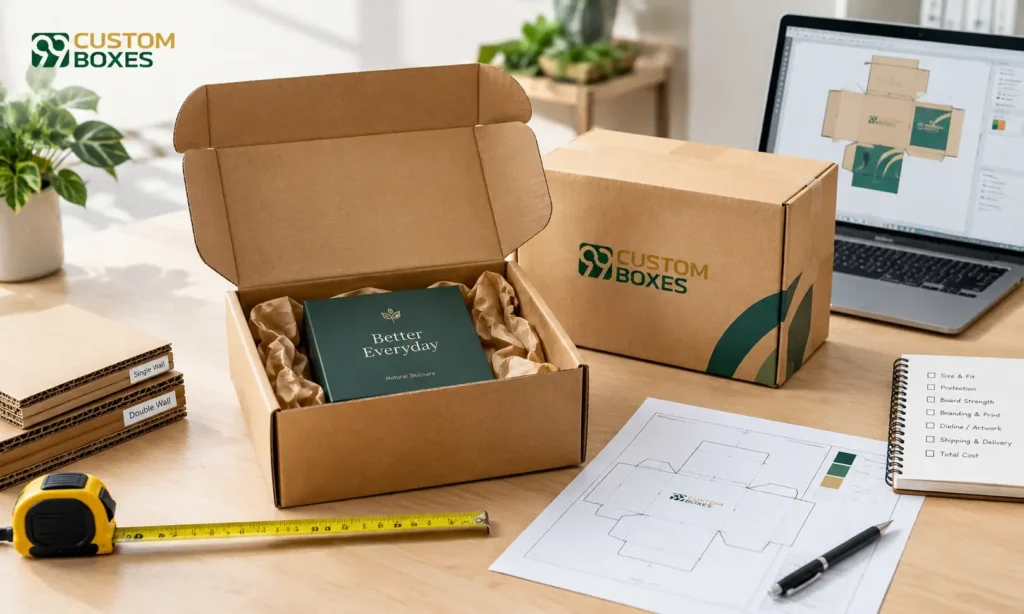
Choosing personalised shipping boxes is not just about putting your logo on a carton. The right packaging needs to fit the product, protect it, work with your packing process, and support how parcels are shipped and presented to customers.
For UK ecommerce brands, online retailers, startups, small businesses and B2B sellers, getting those details right before production can help avoid common problems such as poor product fit, excessive space, unsuitable board strength, difficult packing and unexpected packaging costs.
Before ordering personalised shipping boxes, check these eight areas.
1. Check the Internal Box Dimensions
One of the first questions to ask is: What size shipping box do I actually need?
Start with the product rather than an existing box.
Measure the product’s length, width, and height and consider anything that needs to be included inside the package, such as protective wrapping, inserts or void fill. The internal dimensions need to accommodate the complete packed product, not just the product by itself.
There is also an important difference between internal and external box dimensions.
Internal dimensions help determine whether the product fits inside the box. External dimensions matter when the finished parcel needs to be stored, handled or shipped.
A practical sizing process is:
- Measure the product.
- Add the space needed for protection.
- Account for inserts or dividers where required.
- Decide how closely the product should fit.
- Confirm the final box dimensions before artwork is prepared.
A box that is too small can create pressure on the product or make packing difficult. A box that is unnecessarily large can leave more space to fill and may increase the amount of packaging material required.
For custom shipping boxes, precise sizing is especially useful because the box can be specified around the products you actually dispatch rather than forcing your products into a standard carton.
2. Check Protection and Void Fill Requirements
A shipping box has to do more than look good. It needs to help protect the product throughout the delivery process.
Think about what your product needs before choosing the box structure.
Ask:
- Is the product fragile?
- Does it need cushioning?
- Will multiple items be packed together?
- Does the product need to stay separated from other items?
- Is movement inside the box a concern?
- Will the parcel contain bottles, electronics, retail products, or other items that need additional protection?
Void fill can help reduce unwanted movement inside a shipping box, but too much space can also make packing less efficient.
Depending on the product, protection may involve inserts, dividers, cushioning, wrapping or a closer-fitting box.
This is one reason personalised shipping boxes should be planned around the delivery journey, not only the visual design.
If your products need internal protection, consider whether a standard shipping box is enough or whether a format with inserts would make more sense. You can also explore Custom Mailer Boxes with Inserts when internal product protection is an important part of the packaging specification.
3. Check Corrugated Board Strength and Flute Profile
The material and construction of the box should match the product.
For corrugated shipping boxes, the board’s construction influences how the finished carton handles pressure, stacking, and transport. The right choice depends on factors such as product weight, product fragility, box size, and how the parcel will be handled.
You may come across terms such as:
- Single-wall corrugated board
- Double-wall corrugated board
- E-flute
- Corrugated flute
- Board thickness
- Board strength
Single-wall vs double-wall boxes
Single-wall construction may be suitable for many lighter products and everyday ecommerce shipments.
Double-wall construction can provide additional support where products are heavier, larger or require greater protection.
That does not mean double-wall is automatically the better choice. Using a stronger construction than necessary can add material and weight, while using an unsuitable structure can compromise protection.
The practical objective is to find a balance between:
Product protection + parcel weight + packaging cost
For that reason, provide your packaging supplier with useful information about the product and packed weight before finalising the box specification.
4. Check Shipping Size and Packing Efficiency
The size of a box can affect more than storage.
A larger parcel may require more void fill, take more warehouse space and use more packaging material. Depending on the carrier and service, parcel dimensions can also affect how shipping charges are calculated.
This is where volumetric weight, also called dimensional weight by some carriers, becomes relevant. Shipping companies can use parcel dimensions as part of their charging calculations, so reducing unnecessary space can be an important part of packaging planning.
There is no single box dimension that works for every carrier or service. UK postal and parcel size bands can vary, so check the requirements of the services you actually use before approving the final dimensions. Royal Mail, for example, publishes different weight and dimensional limits across its services.
Before ordering, ask yourself:
- Is there unnecessary space?
- Will the packed parcel fit the shipping service I normally use?
- Could a smaller box reduce void fill?
- Will the box still leave enough room for protection?
- Does the chosen size work across your normal product range?
The goal is right-sized packaging, not simply the smallest possible box.
5. Check the Box Construction and Style
Personalised shipping boxes are available in different constructions, and the best option depends on how the box will be packed, closed, stored, and shipped.
Your packaging may need to prioritise:
- Easy assembly
- Faster packing
- Product presentation
- Additional internal protection
- Secure closure
- Efficient storage
- Compatibility with your products
A mailer-style structure may make sense for certain ecommerce products, while another shipping construction may be more appropriate for heavier or differently shaped goods.
Think about your actual fulfilment process.
If staff or a small business owner is packing dozens or hundreds of orders, the box should not only protect the product. It should also be practical to handle repeatedly.
For businesses comparing shipping packaging and presentation-focused packaging, Custom Mailer Boxes can be another relevant option to consider.
6. Check Your Printing and Branding Requirements
This is where personalised shipping boxes become more than functional packaging.
Your packaging can reinforce your brand through elements such as:
- Logo placement
- Brand colours
- Printed graphics
- Product information
- Messaging
- Interior or exterior print coverage
- Finishing details
The key is to decide what you actually want printed before the box specification is finalised.
For example, a business may only need a simple logo and brand colour on the outside. Another may want a more detailed printed design that supports the entire unboxing experience.
Depending on the packaging format and requirements, 99 Custom Boxes offers printing options that may include CMYK, PMS/Pantone, offset printing, screen printing and spot colours. Finishing options listed for its packaging range include matte and gloss finishes, soft-touch, Spot UV, embossing, debossing and foiling.
Do not choose finishes simply because they are available. Consider whether they improve the intended presentation and fit the product, audience and packaging budget.
The best personalised packaging is not necessarily the most decorated. It is packaging where the design supports the brand without interfering with function.
7. Check the Packaging Dieline and Print-Ready Artwork
A design can look correct on screen and still require changes before production.
Custom packaging artwork is normally prepared against a dieline, which is the flat technical layout used to position artwork around the panels, flaps, folds and cut lines of the box.
Your artwork process should account for:
- Correct box dimensions
- Correct dieline
- Print areas
- Bleed where required
- Colour requirements
- Image quality
- Fonts and fine details
- Safe areas around folds and cuts
Using the wrong template can create problems because box dimensions, construction and panel positions affect the final artwork layout. Current packaging artwork guidance also emphasises using the approved template and checking artwork before production.
Before approving a personalised shipping box order, make sure the artwork matches the exact packaging specification rather than simply reusing a design created for another box size.
This is also a good stage to review how your logo, text, and important information will appear when the box is assembled.
8. Check Quantity and Total Packaging Cost
The cheapest quote is not always the best packaging decision.
When evaluating the cost of custom shipping boxes, consider the factors that can influence the final quotation, such as:
- Box dimensions
- Material or board construction
- Printing requirements
- Number of printed sides
- Finishing and add-ons
- Structural complexity
- Quantity ordered
- Inserts or protective components
- Artwork or design requirements
Quantity can also affect how you evaluate the overall cost. A business ordering for regular ecommerce fulfilment may need a different approach from a startup testing a new product or packaging concept.
99 Custom Boxes lists custom shipping box quantities from 100 to 500,000 boxes per month, depending on the order requirements. The product page also provides options for custom and standard sizes and different materials, printing methods, and finishes.
Rather than asking only, “How much does a custom box cost?”, prepare the information that affects the quote.
You should have your:
box dimensions + quantity + product type + material preference + printing requirements + artwork status
ready before requesting pricing.
This makes it easier to compare realistic packaging options instead of comparing incomplete specifications.
What Information Should You Send When Requesting a Quote?
A packaging quotation becomes much more useful when the supplier has enough information to understand the actual requirement.
Before contacting a custom packaging supplier, prepare:
- Product dimensions
Length, width, and height of the item or packed product. - Required box dimensions
Include any space required for inserts, cushioning, or other protection. - Product weight
This helps with evaluating suitable packaging construction. - Estimated quantity
Tell the supplier how many boxes you need and whether this is a one-off or recurring requirement. - Preferred material or board
You can provide a preference, but it is also reasonable to ask which option fits your product. - Printing requirements
Explain whether you need a logo, full-colour artwork, specific brand colours or other printed elements. - Artwork status
Tell the supplier whether you already have print-ready artwork or need support preparing it. - Target delivery requirements
Share any important deadline early so available production options can be checked.
99 Custom Boxes provides a quote process that asks for dimensions, quantity, printing side, material, card thickness, and artwork, which are useful details to have prepared before an enquiry.
Common Mistakes to Avoid When Ordering Personalised Shipping Boxes
A few packaging decisions can create unnecessary problems later.
Choosing the box before measuring the product
Do not select a standard box first and try to make the product fit afterwards. Start with the product and determine the practical internal dimensions.
Using too much space
Extra space can mean more void fill, less efficient packing and a larger parcel than necessary.
Choosing board strength based only on appearance
A box that looks substantial is not necessarily the most suitable structure for your product. Consider the product weight, fragility and delivery conditions.
Designing artwork before confirming the dieline
The final box structure determines where panels, folds and cut lines sit. Final artwork should be prepared against the appropriate template.
Treating branding as the only priority
The box still needs to perform its main job. Protection, fit and practical packing requirements should be established before the visual design is finalised.
Asking for a quote without enough information
A supplier cannot accurately assess the right box option when dimensions, quantity and packaging requirements are unclear. The more complete your specification, the more useful the quotation can be.
Why Personalised Shipping Boxes Can Make Sense for Ecommerce
For an ecommerce business, the shipping box is part of the customer journey.
The parcel arrives before the customer handles the product itself, so packaging can influence how the delivery is presented.
Personalised shipping packaging can help bring together:
Product protection + practical packing + brand presentation
The important point is that customisation should support the delivery experience rather than exist purely for appearance.
For example, a brand may benefit from a box designed to fit a specific product range, reduce unnecessary space, carry a consistent visual identity and accommodate the protection required during shipping.
For businesses that are still comparing packaging formats, you can also review Small Business Packaging UK or explore Low MOQ Custom Packaging UK when quantity is an important consideration.
Final Checklist Before You Order
Before approving personalised shipping boxes, make sure you can answer these eight questions:
- Do I know the correct internal box dimensions?
- Have I allowed enough room for protection and void fill?
- Is the board strength suitable for the product?
- Does the box size work with my shipping requirements?
- Is the box construction practical for my packing process?
- Do I know exactly what I want printed or branded?
- Is the artwork prepared against the correct dieline?
- Do I understand the quantity and factors affecting the final cost?
Once these details are clear, you are in a much better position to request a useful quotation and compare packaging options.
Need Personalised Shipping Boxes for Your Products?
The right custom shipping box starts with the product, the delivery requirements, and the way you want the packaging to represent your brand.
99 Custom Boxes offers custom shipping boxes with options for size, material, printing, finishes, and structural requirements. You can Explore Custom Shipping Boxes and submit your packaging requirements for a quotation.
Frequently Asked Questions
1. What are personalised shipping boxes?
Personalised shipping boxes are custom packaging boxes designed around a business’s product, dimensions, and branding requirements. They can be customised through size, material, printing, colour, structure and selected finishing options.
2. How do I choose the right size shipping box?
Start by measuring the product’s length, width, and height. Then allow appropriate space for protective materials, inserts or dividers. The aim is to create enough room for safe packing without unnecessary space.
3. What is the difference between internal and external box dimensions?
Internal dimensions describe the usable space inside the box and are important for product fit. External dimensions describe the overall outside measurements and can matter for storage, handling, and shipping requirements.
4. Are single-wall or double-wall shipping boxes better?
Neither is automatically better for every product. Single-wall construction may suit many lighter shipments, while double-wall construction can provide more support for heavier or more demanding applications. The suitable choice depends on the product, packed weight, box size, and delivery conditions.
5. How much do custom shipping boxes cost?
There is no single price that applies to every custom shipping box. Cost can depend on dimensions, board or material, quantity, printing, finishing, structural complexity and additional packaging requirements.
6. What artwork do I need for personalised shipping boxes?
Artwork requirements depend on the packaging design and production method. Custom packaging is typically prepared using the correct dieline so the artwork aligns with the panels, folds and cut areas. Confirm the required template and artwork specifications before final approval.
7. Can small businesses order personalised shipping boxes?
Yes, custom shipping boxes can be suitable for smaller businesses as well as larger ecommerce and wholesale operations. The appropriate quantity and specification depend on expected packaging demand, product requirements, and budget.
8. Should I order a packaging sample before production?
A sample or proof can be useful when you need to check size, structure, artwork or presentation before a larger production order. Whether a physical sample is necessary depends on the complexity and risk associated with the packaging project.
9. Can personalised shipping boxes include a logo and full-colour printing?
Yes. Printing requirements can be specified around your branding and packaging design. Depending on the packaging format, options may include CMYK, Pantone/PMS, offset, screen and spot-colour printing, along with selected finishing options.
10. What should I provide when requesting a custom shipping box quote?
Provide the product dimensions, required box size, estimated quantity, product weight, material preference, printing requirements, and artwork status. Mention any inserts, protection requirements, or important deadlines as well.