
 United States
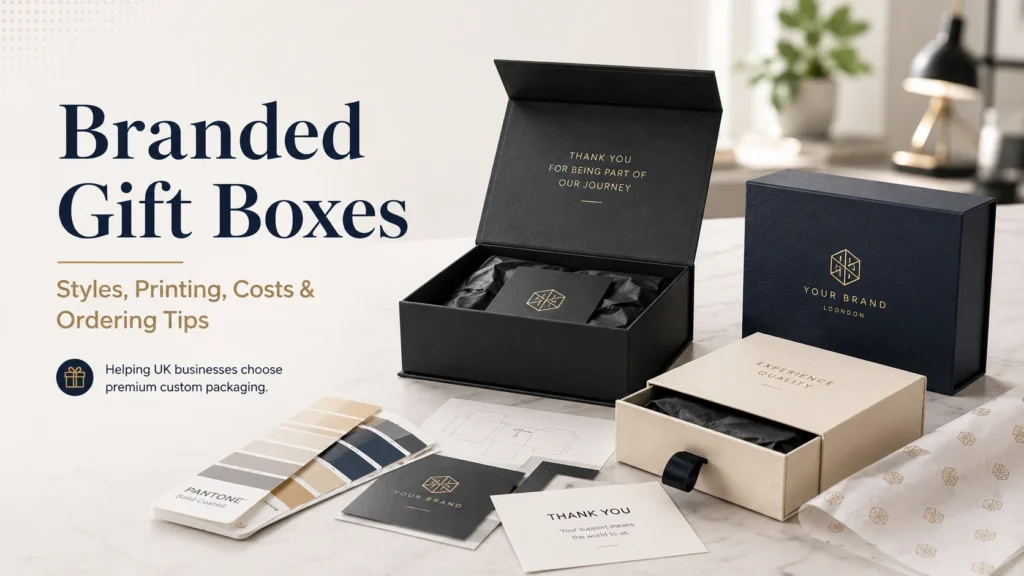
A branded gift box can make a product feel more valuable before the customer even sees what is inside. However, an attractive box is not automatically the right box. The wrong size can increase delivery costs. A weak insert can allow products to move. Too many finishes can push the project over budget or delay an important launch.
The best Branded gift boxes balance presentation, product protection, cost and ease of use. A jewellery business may need a compact rigid box with a fitted insert, while a corporate gifting company may need larger boxes that staff can assemble quickly. The right choice depends on how the box will be filled, stored, transported and opened.
What Are Branded Gift Boxes?
Branded gift boxes are packaging boxes customised with a company’s logo, colours, message or artwork. Businesses use them for retail products, corporate gifts, subscription sets, influencer mailers, PR campaigns and seasonal promotions.
Branding can be added through:
- Digital or full-colour printing
- Foil stamping
- Embossing or debossing
- Spot UV coating
- Printed sleeves
- Branded tissue paper
- Internal lid printing
- Custom inserts
- Ribbons, labels or belly bands
The box does more than display a logo. It creates a controlled presentation. Products stay organised, important information is easy to see, and the recipient gets a more complete brand experience.
Which Branded Gift Box Style Should You Choose?
The box structure has a greater effect on price and usability than most businesses expect. A premium material cannot fix a structure that is difficult to assemble, expensive to store or unsuitable for the product.
| Box style | Best suited to | Main benefit | Main trade-off |
| Folding carton | Cosmetics, confectionery and small retail items | Lightweight and economical | Less premium than rigid packaging |
| Lid-and-base rigid box | Jewellery, candles and luxury gifts | Strong structure and classic presentation | Takes more storage space |
| Magnetic closure box | Corporate gifts, PR kits and premium products | Impressive opening experience | Higher production and delivery cost |
| Drawer-style box | Accessories, skincare and small gift sets | Distinctive sliding reveal | Requires accurate sizing |
| Mailer-style gift box | Ecommerce gifts and subscription sets | Protection and presentation in one format | May need an insert for small items |
| Collapsible rigid box | Premium products ordered in volume | Luxury appearance with easier storage | Requires assembly before packing |
| Pillow or gable box | Events, samples and lightweight gifts | Simple and cost-effective | Limited protection and internal space |
Magnetic Closure Gift Boxes
Magnetic closure gift boxes work well when the opening experience is part of the product presentation. Concealed magnets hold the lid in place and create a clean finish without visible tabs.
They are commonly used for:
- Corporate gift packs
- Luxury skincare collections
- Technology accessories
- Influencer boxes
- Product launch kits
- Premium confectionery
Traditional Rigid magnetic boxes usually arrive assembled and take up more warehouse space. Collapsible versions can reduce storage and transport volume, although staff must fold and secure them before packing. Rigid box suppliers also offer book-style and folding magnetic structures for different operational needs.
Choose a magnetic box when presentation and reuse matter more than achieving the lowest possible unit price.
Lid-and-Base Rigid Boxes
A lid-and-base box has two separate pieces. It feels solid, opens easily, and works across many premium product categories.
This style is a practical choice for:
- Jewellery
- Watches
- Candles
- Fragrances
- Clothing accessories
- Business gifts
The design is simpler than many magnetic structures, which can make it easier to produce at different sizes. It also provides large flat areas for logos, foil, patterns and printed messages.
Drawer-Style Gift Boxes
Drawer-style gift boxes use an outer sleeve and an inner tray. Pull tabs or ribbons may be added to make opening easier.
The sliding action creates a slow product reveal, making the box suitable for small products that benefit from careful presentation. The main risk is poor tolerance. If the drawer is too tight, it becomes frustrating to open. If it is too loose, the inner tray may slide out during handling.
A physical sample is especially valuable for this style because screen proofs cannot show how smoothly the drawer moves.
Folding and Mailer Boxes
Folding cartons and mailer boxes are often better for brands that need lower weight, flat storage or easier fulfilment.
They may not feel as substantial as rigid gift box packaging, but good artwork, clean printing and a well-designed insert can still create a premium result. They are useful for growing ecommerce brands that need to control packaging and shipping costs without using plain boxes.
Standard Sizes or Bespoke Branded Gift Boxes?
A standard-sized box is usually the faster and more economical option. The structure already exists, so customisation may only involve printing, foiling or adding a sleeve.
Standard boxes work well when:
- Your product fits an existing size
- You need a smaller quantity
- Your deadline is close
- You want to avoid structural tooling
- You only need simple logo branding
Bespoke branded gift boxes are made around the product. The dimensions, opening style, material, inserts and print layout can all be customised.
Bespoke packaging becomes worthwhile when:
- The product has an unusual size or shape
- Several items must stay in fixed positions
- Excess empty space would harm the presentation
- The packaging must match a premium price point
- A distinctive opening experience is important
- Standard boxes create high postage or storage costs
The smallest possible box is not always the best box. Products still need enough clearance for easy packing, protective inserts and manufacturing tolerances.
Choosing the Right Printing Method
The best print method depends on the artwork, material, order size and required colour accuracy.
Digital and Full-Colour Printing
Digital printing is useful for detailed artwork, photographs, gradients and designs with several colours. It can also suit shorter runs because it does not always require the same plate setup as traditional printing methods.
It works well for:
- Colourful ecommerce packaging
- Seasonal artwork
- Event boxes
- Small product launches
- Multiple artwork versions
- Personalised gift boxes for businesses
Digital printing is flexible, but colours shown on a laptop or phone may not match the printed result exactly. Screens display light, while printed packaging reflects ink from a physical surface.
Always review a proof, especially when brand colours are important.
CMYK and Pantone Colours
CMYK combines cyan, magenta, yellow and black to produce a wide range of printed colours. It is suitable for images, gradients and full-colour designs.
Pantone spot colours are often used when a company needs a more controlled brand colour. Pantone’s Color Bridge system allows designers to compare a solid Pantone colour with its CMYK simulation, but the result can still change depending on the board, coating and print process.
Pantone printing may be useful for:
- A specific corporate colour
- A simple one- or two-colour design
- Consistency across repeated packaging orders
- Logos where colour accuracy is critical
Ask whether your quotation includes CMYK, Pantone colours or a combination of both. Additional spot colours may involve extra setup and cost.
Premium Finishes: Which Ones Add Real Value?
Finishes should support the design rather than compete with it. A box covered in foil, embossing and gloss effects can look less refined than a simple box with one carefully placed detail.
Foil Stamping on Boxes
Foil stamping on boxes applies a metallic or coloured foil using heat and pressure. Gold and silver are common, but copper, rose gold, holographic and coloured foils are also available.
Foil is effective for:
- Logos
- Borders
- Product names
- Short messages
- Small decorative details
It works best with clean artwork. Very thin lines and tiny text may not reproduce well, depending on the material and production process.
Embossing and Debossing
Embossing and debossing packaging adds physical depth.
- Embossing raises the design above the surface.
- Debossing presses the design into the surface.
Both create a tactile effect that customers can feel. They work well for logos and simple patterns, but require tooling and careful alignment.
Combining embossing with foil can create a strong result, although it adds production steps. Custom finishes such as foil, embossing, spot coatings and specialist inserts increase tooling, proofing and handling requirements, particularly for smaller runs.
Spot UV Packaging Printing
Spot UV packaging printing adds a glossy coating to selected areas. It is often placed over a logo, pattern or text on a matt background.
The contrast can look premium without using metallic foil. It is most effective when the gloss area is large enough to be noticed but not so large that it covers the complete design.
Lamination and Soft-Touch Finishes
Matt lamination reduces glare and creates a smooth surface. Gloss lamination makes colours look brighter and provides a shinier finish. Soft-touch lamination has a velvety feel and is often used for luxury branded gift boxes.
Lamination can improve appearance and surface protection, but it may affect how easily the packaging can be recycled. Ask whether a coating, film or finish changes the material’s recycling route.
Do Branded Gift Boxes Need Inserts?
A beautiful box can still disappoint if the products move, rattle or arrive out of position. Branded gift boxes with inserts keep items secure and improve presentation.
| Insert material | Best for | Advantages | Considerations |
| Die-cut card | Cosmetics, stationery and light products | Printable and widely recyclable | Limited cushioning |
| Corrugated card | Bottles, jars and heavier products | Strong and cost-effective | More functional appearance |
| Moulded pulp | Skincare, candles and eco-focused products | Formed fit and paper-based feel | Tooling may be required |
| EVA or PE foam | Electronics, glass and premium sets | Accurate fit and strong protection | Harder to recycle |
| Fabric-covered foam | Jewellery and luxury products | Soft, premium presentation | Higher material and assembly cost |
| Paper shred or tissue | Hampers and mixed gifts | Flexible and easy to use | Products may still move |
An insert should be designed around the actual product, not only its listed dimensions. Bottles may have pumps, lids, or uneven bases. Cables need space to bend. Fabric products may expand after folding.
Before approving the insert, test:
- Product fit
- Finger access
- Removal effort
- Movement during transport
- Space for instructions or accessories
- How the box looks after the product is removed
A cavity that fits too closely can make the product difficult to lift. Small thumb cuts or finger notches can solve this problem without changing the complete structure.
What Affects the Cost of Branded Gift Boxes?
There is no reliable fixed price for all custom gift packaging. The gift box cost per unit changes according to the complete specification.
The main cost factors are:
- Box dimensions
Larger boxes use more material and occupy more delivery and storage space. - Structure
Folding cartons are usually simpler than rigid magnetic or multi-part drawer boxes. - Material
Board thickness, wrap paper, kraft stock, textured paper and specialist materials have different prices. - Order quantity
Setup and tooling costs are spread across the production run. A larger quantity often lowers the unit price, but it also increases total spend and storage needs. - Print coverage
A small logo on one panel is normally simpler than full-colour printing inside and outside. - Special finishes
Foiling, embossing, debossing, spot UV and soft-touch coatings add processes and may require separate tooling. - Custom inserts
Card inserts are generally simpler than precision foam or moulded trays. - Assembly
Pre-assembled rigid boxes may save packing time but cost more to store and transport. - Proofs and samples
A plain sample, digitally printed mock-up and production-grade sample have different costs. - Delivery and VAT
Compare the total amount payable, not only the displayed box price.
Custom packaging quotations may include artwork preparation, print setup, tooling, delivery and VAT separately. A low headline unit price can therefore become more expensive once every charge is added.
Calculate the True Cost per Usable Box
Use this simple calculation:
Total project cost ÷ number of usable boxes received = true cost per box
The total project cost should include:
- Boxes
- Printing
- Tooling
- Inserts
- Samples
- Assembly
- Delivery
- VAT where applicable
- Storage or handling costs
Also consider the cost of unused stock. Ordering 5,000 boxes may reduce the unit price, but it is not good value if the artwork changes after 1,500 units.
How Minimum Order Quantities Affect Your Decision
The gift box minimum order quantity is the smallest number of boxes a supplier will produce under a particular specification.
Minimums often exist because the supplier must prepare files, machines, cutting tools, printing plates, or finishing equipment before production starts. These fixed tasks cost almost the same whether the run contains 100 boxes or 1,000 boxes.
A lower minimum can be useful for:
- New product testing
- Limited editions
- Small business launches
- Seasonal campaigns
- Influencer gifting
- Product photography
- Approval before a larger order
A higher-volume order may offer a lower unit price, but only order what the business can realistically use before the packaging becomes outdated.
99 Custom Boxes states that it does not apply a fixed minimum order, allowing businesses to order a single sample or a larger production run. The company also provides digital proofs and physical samples before full production.
Eco-Friendly Gift Packaging Needs Specific Claims
The phrase eco-friendly gift packaging is too broad on its own. Ask what makes the packaging a better environmental choice.
Useful questions include:
- Is the board recyclable in normal UK paper streams?
- Is the packaging made from recycled material?
- Is the paper responsibly sourced?
- Can plastic windows, magnets or ribbons be removed?
- Is the insert made from the same material as the box?
- Has unnecessary material been removed?
- Can the box be reused?
- Does the finish affect recyclability?
FSC-Certified Packaging Materials
FSC certification can help businesses demonstrate responsible sourcing of paper and forest-based packaging materials. FSC UK notes that forest-fibre packaging can be renewable and recyclable when it is responsibly sourced and sensitively processed.
Do not place an FSC logo on packaging simply because the board has been described as sustainable. The relevant supply chain, product and logo use must meet FSC requirements.
Keep UK Packaging Responsibilities in Mind
Some UK organisations that supply or import packaging must collect and report packaging data under extended producer responsibility rules. Current government guidance applies reporting requirements when specified turnover, packaging-weight and activity conditions are met.
Smaller brands may not meet those thresholds, but packaging weight and material choices are still worth recording. Accurate specifications make future reporting, sustainability reviews and supplier comparisons easier.
How Long Do Custom Packaging Orders Take?
Custom packaging lead times normally begin after the artwork and structural design have been approved, not when the first enquiry is sent.
The schedule may include:
- Quotation
- Structural design
- Artwork preparation
- Digital proof
- Physical sampling
- Revisions
- Material sourcing
- Printing
- Finishing
- Assembly
- Quality checks
- Delivery
Foiling, embossing, custom inserts and several colour variations can extend production. Some UK suppliers note that complex foil or embossing work may add several days, while new inserts require drawings and fit testing.
99 Custom Boxes states that most custom orders are completed within 6–10 business days after design approval, with rush options available for urgent projects. Exact timing still depends on the box style, quantity, finishes and delivery arrangement.
For an event or product launch, work backwards from the date the packed boxes must leave your premises. Do not use the event date as the packaging delivery deadline.
A Practical Ordering Process
1. Confirm What Goes Inside
List every product, accessory, leaflet and promotional item. Measure the real items rather than relying only on website specifications.
2. Decide How the Box Will Be Used
Clarify whether the box is for:
- Retail shelves
- Direct ecommerce delivery
- Corporate gifting
- An event
- A PR campaign
- A subscription
- A presentation meeting
A presentation box may still need a separate shipping carton if it is being sent through a courier network.
3. Set a Realistic Budget
Share the target quantity and total packaging budget. A supplier can then suggest which structures and finishes provide the strongest result within that range.
4. Choose the Structure Before the Artwork
The dieline controls where text, logos, folds and closures appear. Designing artwork before confirming the structure often creates unnecessary revisions.
5. Prepare Suitable Artwork
Vector logo files are generally better for sharp printing and foiling. Supply brand colours, fonts and any placement rules.
Do not rely on a small PNG copied from a website.
6. Request a Proof or Sample
A digital proof checks layout and spelling. A physical sample checks size, material, opening action and product fit.
For large orders, unusual products or premium finishes, a physical sample provides stronger protection against expensive mistakes.
7. Check the Complete Quote
Confirm whether the price includes:
- Artwork support
- Dielines
- Printing
- Foil or embossing tools
- Inserts
- Assembly
- Samples
- Delivery
- VAT
- Reorder tooling
8. Approve Every Detail in Writing
Check the dimensions, material, colours, quantity, finish, delivery address and deadline. A final approval should remove uncertainty for both sides.
Common Ordering Mistakes
Choosing Appearance Before Function
A magnetic box may look impressive but could be unnecessary for a low-cost sample product. A lighter folding box may support the same campaign more efficiently.
Using Too Much Empty Space
Large boxes can increase material, void fill, storage and courier costs. They may also make a small product appear less valuable.
Ignoring the Packing Team
A complex flat-pack box may save storage space but slow down fulfilment. Test how long one person takes to assemble, fill and close it.
Approving Colours Only on Screen
Colours change across screens, printing methods and materials. Ask for a printed proof when colour accuracy matters.
Forgetting Reorder Details
Confirm whether the supplier will retain dielines, foil blocks or cutting tools. Keep the final artwork reference and approved specification in a central file.
Ordering Too Close to a Launch
Late approvals create rushed decisions. They can also increase delivery costs and leave no time to correct a sample.
Best Choices for Common Business Scenarios
For a Small Skincare Launch
Choose a folding carton or mailer-style box with a die-cut card insert. Use full-colour printing and one premium detail, such as foil on the logo.
This keeps the structure practical while making the product feel considered.
For Corporate Branded Gift Boxes
Choose a magnetic closure or lid-and-base rigid box. Add a card or corrugated insert for multiple items and print a short message inside the lid.
Focus on easy packing when hundreds of boxes must be prepared for the same event.
For Jewellery or Watches
Use a compact rigid box with a soft insert. Debossing or a small foil logo may provide enough branding without covering the box in decoration.
For Influencer or PR Mailers
Use a mailer or presentation box with internal printing. The layout should make the products camera-ready as soon as the lid opens.
Avoid deep boxes that hide products below tissue or filler.
Create Branded Gift Boxes That Work Beyond the First Impression
Successful branded gift packaging must look good, protect the contents, and fit the way the business operates. The right structure reduces wasted space. The right insert keeps products organised. The right print method presents the brand clearly without adding unnecessary cost.
99 Custom Boxes supports UK businesses with custom sizes, logo printing, structural options, inserts, digital proofs and physical samples. Share your product dimensions, quantity and preferred style to receive a clear recommendation for your packaging project.
Request a free quoteand compare the most suitable branded gift box options for your product.
Frequently Asked Questions
How much do branded gift boxes cost in the UK?
The cost depends on size, material, structure, quantity, printing, finishes, inserts and delivery. A simple printed folding box normally has a lower cost profile than a rigid magnetic box with foil and a custom foam insert. Compare the total quote rather than the unit price alone.
Can I order branded gift boxes with my logo?
Yes. Branded gift boxes with logo designs can use digital printing, Pantone colours, foil stamping, embossing, debossing or printed sleeves. The best method depends on the artwork and desired finish.
What is the best box for corporate gifts?
Magnetic closure boxes, lid-and-base rigid boxes and strong presentation mailers are common choices. The best structure depends on the weight, number of products, delivery method and packing process.
Are rigid gift boxes better than folding cartons?
Rigid boxes feel more substantial and may offer a stronger premium presentation. Folding cartons are lighter, easier to store and often more economical. Neither option is automatically better; the right one depends on the product and budget.
Should I request a sample before ordering?
Yes, especially for bespoke dimensions, drawer boxes, inserts, colour-sensitive artwork or large orders. Custom gift box samples help identify fit, print and usability problems before full production.
Can gift boxes be printed inside and outside?
Yes. Internal printing can add instructions, a campaign message, product information or a design reveal. It also increases print coverage, so include it when requesting a quotation.
What information is needed for a quote?
Provide the box dimensions, product details, quantity, preferred style, material, artwork, finishes, insert needs, delivery postcode and required date. Photos of the product can also help the packaging team understand its shape and handling needs.
How can I reduce the cost per box?
Use efficient dimensions, avoid unnecessary finishes, consider standard structures, increase quantity only when the stock will be used, and compare flat-pack with assembled options. A simple design that is easy to manufacture often gives better value than several decorative effects.