
 United States
Premium packaging does more than hold a product. It shapes the first impression, protects the item, and affects how customers remember the brand.
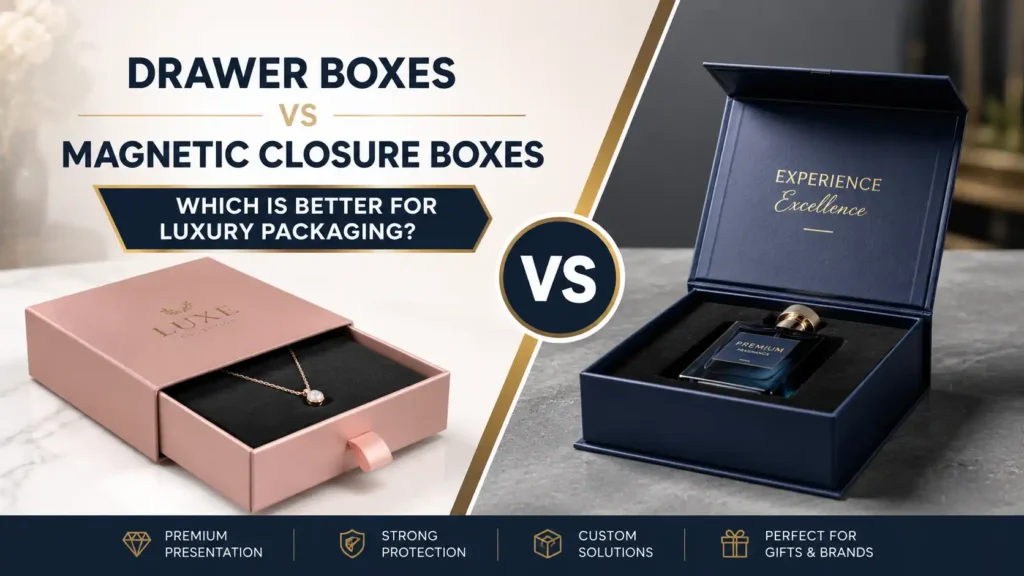
The difficulty starts when two box styles look equally suitable. Drawer Boxes vs Magnetic Boxes is a common comparison for jewellery, cosmetics, gift sets, electronics and other high-value products. Both options use a strong, rigid structure, support custom printing, and create a premium opening experience. However, they do not work in the same way.
Drawer boxes provide a slow, controlled product reveal. Magnetic closure boxes offer a clean opening action and a secure closing feel. The better choice depends on your product, packing process, storage space, budget, and customer experience.
Quick answer: Choose a drawer box for a distinctive sliding reveal and compact presentation. Choose a magnetic closure box when easy opening, strong visual impact, and a book-style presentation matter more.
What Are Drawer Boxes in Packaging?
A drawer box has two main parts:
- An outer sleeve
- An inner sliding tray
The tray moves in and out of the sleeve like a drawer. For this reason, the style is also called a sleeve and tray box, slide box, or sliding rigid box.
Rigid drawer boxes usually use thick board wrapped in printed or decorative paper. The tray may include a ribbon pull, thumb cut, fabric tab, or recessed opening to make it easier to slide out.
99 Custom Boxes describes its custom drawer boxes as sliding structures that can be made with custom sizes, inserts, printed designs, finishes, and materials for products such as jewellery, cosmetics, chocolates, and gifts.
Benefits of Drawer Box Packaging
The main advantage is the way the product appears.
Instead of showing everything as soon as the lid opens, the tray creates a short reveal. That small pause can make the product feel more considered and valuable.
Other benefits include:
- Distinctive opening experience: The sliding movement feels different from a standard lid.
- Strong product presentation: The tray frames the product clearly.
- Good insert compatibility: Foam, card, moulded pulp or fabric-covered inserts can sit inside the tray.
- Compact appearance: Small drawer boxes work well for products that need a neat display.
- Useful branding space: The sleeve, tray front and inner surface can carry different design elements.
- Reusable structure: Customers may keep a well-made box for storage.
Drawer boxes can also be useful when the opening sequence supports the product story. A jewellery brand, for example, can place its logo on the sleeve and reveal the item only after the customer pulls the ribbon tab.
Limitations of Drawer Boxes
A drawer box is not automatically the best option for every premium product.
The sliding tray needs the correct amount of friction. If the fit is too loose, the tray may move during handling. If it is too tight, customers may struggle to open it.
Other practical limits include:
- The tray may need a pull tab or thumb cut.
- Poor tolerances can create an uneven sliding action.
- Deep or heavy products may require stronger tray support.
- The sleeve can add board and production cost.
- Staff may need more time to insert the tray during packing.
A physical sample is important because the opening feel cannot be judged from artwork alone.
What Are Magnetic Closure Boxes?
A Magnetic closure box normally has a hinged lid or folding flap with concealed magnets. The magnets align when the lid closes, producing a smooth and secure closing action.
Many magnetic boxes open like a book. Others use a fold-over lid or a collapsible construction. The structure is popular for corporate gifts, presentation kits, skincare sets, luxury retail products, and influencer packages.
Rigid magnetic boxes from 99 Custom Boxes use rigid board with hidden magnets and can be customised with different sizes, printing, finishes and insert styles.
Benefits of Magnetic Closure Boxes
The closing action is the feature customers notice first. A well-aligned magnetic lid closes neatly without a visible locking tab.
Key benefits include:
- Easy access: The lid opens without removing a separate part.
- Premium closing feel: Concealed magnets create a clean finish.
- Large branding area: The lid provides space for a logo, message or artwork.
- Good product visibility: The full interior can be seen when the lid opens.
- Suitable for sets: A wide box can hold several products in one fitted insert.
- Useful for gifting: The presentation resembles a keepsake or presentation case.
Magnetic closure boxes are especially practical when the inside of the lid carries a message, instructions, or campaign artwork. This makes them useful for PR mailers and gift collections where the brand wants to control the first view.
Limitations of Magnetic Closure Boxes
Magnets improve the closure, but they do not replace protective packaging.
A heavy product can still move inside the box if the insert is poorly designed. A magnetic box may also need an outer mailer when sent through a courier network.
Other trade-offs include:
- Concealed magnets add materials and production steps.
- Fixed rigid boxes can take up significant storage space.
- Large hinged lids may need careful board and hinge testing.
- Magnets and mixed-material finishes can complicate recycling.
- Weak magnet placement may cause an uneven closure.
- The style may cost more than a simple two-piece rigid box.
Collapsible magnetic gift boxes can reduce storage volume before assembly, but packing staff must fold and secure each box correctly.
Drawer Boxes vs Magnetic Boxes: Key Differences
| Decision factor | Drawer box | Magnetic closure box |
| Opening style | Sliding tray | Hinged or folding lid |
| Customer experience | Slow, controlled reveal | Immediate, wide presentation |
| Best for | Compact products and single-item displays | Gift sets, kits and larger presentations |
| Closure | Sleeve friction | Concealed magnets |
| Insert options | Foam, card, fabric or moulded inserts | Foam, card, fabric or moulded inserts |
| Branding space | Sleeve, tray front and interior | Large lid, sides and interior |
| Packing process | Tray must slide into the sleeve | Product is placed into an open base |
| Storage | Fixed structure may take space | Fixed versions take space; collapsible versions save room |
| Common risk | Tray too tight or loose | Weak hinge or poor magnet alignment |
| Unboxing effect | Suspense and product reveal | Strong first view and closing feel |
Neither style is better in every situation. The correct choice is the one that works with the product and the way the business handles it.
Which Is the Best Rigid Box Style for Luxury Packaging?
The best rigid box style should solve three problems:
- Hold the product securely.
- Support the desired brand experience.
- Work within real packing, storage, and delivery conditions.
Appearance matters, but it should not be the first decision.
Choose a Drawer Box When the Reveal Matters
A drawer box is often the stronger choice when the brand wants the customer to discover the product gradually.
It works well for:
- Watches
- Jewellery
- Small skincare items
- Chocolates and confectionery
- Fragrance products
- Premium accessories
- Gift cards
- Small electronic devices
The design can guide the eye towards one central product. A ribbon pull can also become part of the brand style.
Drawer boxes are less suitable when customers need to access a large collection of items at once. A very wide tray can become awkward, especially when the contents are heavy.
Choose a Magnetic Closure Box for a Full Presentation
A magnetic closure box is often better when several products must be displayed together.
Common uses include:
- Corporate gift sets
- Influencer mailers
- Cosmetics collections
- Subscription gift boxes
- Product launch kits
- Luxury clothing accessories
- Technology bundles
- Welcome packs
The hinged lid provides a broad surface for internal printing. When the lid opens, the complete arrangement becomes visible without removing a sleeve or separate top.
Which Box Is Better for Jewellery?
There is no single best packaging box for jewellery. The answer depends on the product and how it is sold.
A compact drawer box can work well for:
- Rings
- Earrings
- Pendants
- Bracelets
- Individual watches
The tray creates a focused display, while a fitted insert keeps the item in the correct position.
A magnetic closure box may be better for:
- Multi-piece jewellery sets
- Necklace and earring combinations
- Watches with accessories
- Gift collections
- Presentation boxes with certificates or care cards
The insert is more important than the opening mechanism. A beautiful rigid box will still feel poor if the jewellery moves, turns sideways or touches the lid.
For jewellery packaging, check:
- Insert cut-out size
- Fabric softness
- Product weight
- Chain and clasp position
- Clearance above the item
- Space for certificates or cleaning cloths
- Resistance to movement during delivery
A compact rigid box with a soft insert is also recommended on the company’s branded gift packaging page for jewellery and watches.
How Materials and Finishes Affect the Result
Most luxury rigid packaging boxes use a strong board core covered with a printed, coloured or textured wrap. The quality of the final box depends on more than board thickness.
Important elements include:
Board Strength
The board should support the product without bending. Heavier items may need thicker board, reinforced corners, or a stronger insert.
Using the thickest board is not always necessary. Excess board can increase weight, material use, and cost without improving the customer experience.
Outer Wrap
The wrap controls much of the visual appearance. Options may include:
- Printed paper
- Coloured paper
- Textured paper
- Kraft-style paper
- Soft-touch lamination
- Matt or gloss lamination
Dark solid colours can show scuffs, fingerprints and corner marks more easily than patterned or lighter wraps. A sample helps reveal these issues before a full order.
Luxury Packaging Finishes
Common finishing options include:
- Foil stamping
- Embossing
- Debossing
- Spot UV
- Printed patterns
- Inside-lid printing
- Ribbon pulls
- Fabric tabs
Luxury gift boxes available from 99 Custom Boxes can be specified with rigid board, fitted inserts, magnetic closures, and finishes such as foil stamping, embossing, and spot UV.
A finish should support the brand rather than compete with the product. A small foil logo may create a stronger premium impression than several finishes used at once.
The Insert Often Matters More Than the Box Style
Businesses sometimes spend most of the packaging budget on the outer box and treat the insert as an afterthought.
That can lead to:
- Products moving during delivery
- Uneven presentation
- Scratched surfaces
- Bottles touching each other
- Difficult product removal
- Empty spaces that make the box feel oversized
Custom rigid box inserts should match the weight, shape, and handling needs of the product.
Possible insert materials include:
- Die-cut card
- Corrugated board
- Foam
- Moulded pulp
- Fabric-covered board
- Paper-based supports
Foam provides cushioning and precise cut-outs, but it may not suit a brand seeking simple material separation. Card and moulded-fibre options can offer a more paper-based presentation, although the right choice still depends on product protection.
Operational Details That Affect the Final Choice
Packaging buyers often compare designs on appearance alone. Production and fulfilment teams see a different side of the decision.
Packing Speed
A magnetic box stays open while products are loaded, which can make packing a multi-item set easier.
A drawer box requires the filled tray to slide into the sleeve. This is simple for small products, but the process may slow down when the tray is large, tightly fitted, or heavily loaded.
Storage Space
Fixed rigid boxes arrive assembled and can use a large amount of warehouse space. This matters when thousands of boxes are ordered for seasonal demand.
Collapsible magnetic boxes reduce storage volume, but they add an assembly step. The time needed to build each box should be included in the real packing cost.
Transit Protection
Rigid packaging is often presentation packaging rather than a complete shipping solution.
For ecommerce orders, consider:
- An outer corrugated mailer
- Void fill around the presentation box
- Corner protection
- Scuff protection
- Moisture exposure
- Drop and vibration testing
A magnetic lid should not be expected to remain closed through every courier impact without suitable outer protection.
Repeat Production
Luxury packaging often uses large areas of brand colour. Colour can vary across print processes, materials and production runs.
Ask for:
- Approved artwork proofs
- Material samples
- Finish samples
- Pantone references where needed
- A finished structural prototype
- Clear tolerances for inserts and closures
Keeping an approved sample gives the supplier and buyer a physical reference for repeat orders.
Sustainability Requires More Than a Recyclable Claim
Paper-based packaging can support lower-plastic packaging goals, but a rigid box should not be described as recyclable based only on its outer paper wrap.
The complete structure may include:
- Rigid board
- Laminated paper
- Magnets
- Foam
- Fabric
- Adhesives
- Ribbons
- Plastic windows
FSC certification relates to responsible forest-based material sourcing and chain-of-custody controls. It does not automatically mean that every finished packaging structure can enter household recycling. FSC UK notes that certification can help organisations specify and source forest-based packaging more responsibly.
UK recyclability assessment also considers packaging materials and components rather than relying on broad environmental wording. Government guidance for the Recyclability Assessment Methodology is updated as the system develops.
For more responsible rigid packaging, consider:
- FSC-certified paper or board where available
- Recycled-content board
- Minimal lamination
- Paper-based inserts
- Removable non-paper components
- Smaller boxes with less space
- Reusable structures
- Clear disposal instructions
A drawer box without magnets may be easier to simplify into a mostly paper-based structure. However, coatings, adhesives, ribbons, and inserts still need to be checked.
Common Mistakes When Choosing Rigid Packaging Boxes
Choosing the Box Before Measuring the Product
Internal dimensions should account for the product, insert, and removal space. An insert cannot fix a box that is fundamentally the wrong size.
Paying for Finishes Before Testing the Structure
Foil and embossing cannot improve a tray that sticks or a magnetic lid that does not align.
Approve the structure first. Add decorative finishes after the opening action, fit, and protection are correct.
Making the Box Larger to Look More Premium
Oversized packaging can increase material use, storage needs, and shipping costs. It can also disappoint customers when a small product sits inside a large empty box.
Ignoring Fulfilment Staff
The people packing the product should test the sample. They can identify slow assembly, awkward inserts, and closure problems before production.
Treating the Box as Shipping Protection
A luxury rigid box may still need an outer delivery box. Test the complete packaging system rather than only the presentation box.
How to Choose Between Drawer and Magnetic Packaging
Use the following process before requesting production.
- Measure the product accurately. Include accessories, inserts, and protective materials.
- Define the opening experience. Decide whether you want a gradual reveal or an immediate full display.
- Review the packing process. Consider how many boxes staff must fill each day.
- Check storage capacity. Compare fixed and collapsible structures.
- Choose the insert early. The insert affects internal size, protection, and presentation.
- Plan for delivery. Decide whether an outer shipping box is required.
- Select materials and finishes. Use only the options that support the brand and product.
- Request a physical sample. Test fit, movement, closure, scuffing and ease of opening.
- Compare the complete cost. Include assembly, storage, inserts and delivery—not only the price per box.
Drawer Boxes vs Magnetic Boxes: The Final Choice
Choose drawer boxes when the product needs a compact format, a controlled reveal and a distinctive sliding action. They are particularly effective for jewellery, watches, confectionery and smaller luxury products.
Choose magnetic closure boxes when the packaging needs easy access, a wide presentation area and space for multiple products. They are well suited to gift collections, corporate kits, cosmetics sets and campaign mailers.
The best decision is not based on which box looks more expensive. It comes from matching the structure to the product, insert, packing workflow and customer experience.
99 Custom Boxes provides custom drawer boxes, magnetic closure boxes, inserts, printing and luxury packaging finishes for UK businesses. Request a quote to compare the fit and presentation before choosing a full production run.
Frequently Asked Questions
1. Are drawer boxes more expensive than magnetic boxes?
The cost depends on size, board thickness, quantity, insert, printing and finishes. Drawer boxes require a sleeve and sliding tray, while magnetic boxes require magnets and a hinged structure. A supplier needs the complete specification to make a fair comparison.
2. What are magnetic closure boxes used for?
They are commonly used for corporate gifts, cosmetics sets, electronics, jewellery collections, promotional kits and high-value retail products. Their hinged lid provides a large presentation and branding area.
3. Can drawer boxes include custom inserts?
Yes. Drawer boxes can hold foam, card, moulded pulp or fabric-covered inserts. The insert should be designed with the tray so the product fits securely and remains easy to remove.
4. Which rigid box style creates the best unboxing experience?
Drawer boxes create a slower reveal, while magnetic boxes provide an immediate view of the full presentation. The better experience depends on the product and the emotion the brand wants to create.
5. Are magnetic boxes recyclable?
Some parts may be recyclable, but the complete answer depends on the board, wrap, coating, magnets, adhesives, and insert. Ask the supplier for a material breakdown and provide suitable disposal instructions.
6. Are drawer boxes suitable for posting?
They can be used for ecommerce, but a rigid drawer box may still need an outer corrugated mailer and protective material. Test the complete pack for movement, scuffing and courier handling.
7. What is the difference between magnetic boxes and lid-and-base boxes?
A magnetic box normally has a hinged lid secured with concealed magnets. A lid-and-base box has a separate lift-off lid. Lid-and-base boxes offer a classic presentation, while magnetic boxes provide a connected lid and a distinct closing action.
8. Should I request a sample before ordering rigid boxes?
Yes. A finished sample allows you to test size, insert fit, opening action, closure, colour, finishes, and product protection. It can prevent expensive changes after bulk production.