
 United States
A box can look like the right size and still cause problems. It may leave too much space, crush the product, increase postage costs, or fail to meet a courier’s parcel limits.
The common mistake is measuring only the product or only the outside of an existing box. For accurate custom packaging, three measurements matter:
- The product dimensions
- The internal box dimensions
- The external box dimensions
Knowing how to measure a box correctly helps you order packaging that protects the product, fits your inserts, and avoids unnecessary shipping costs.
The Quick Answer: How Do You Measure a Box?
Measure an assembled box in this order:
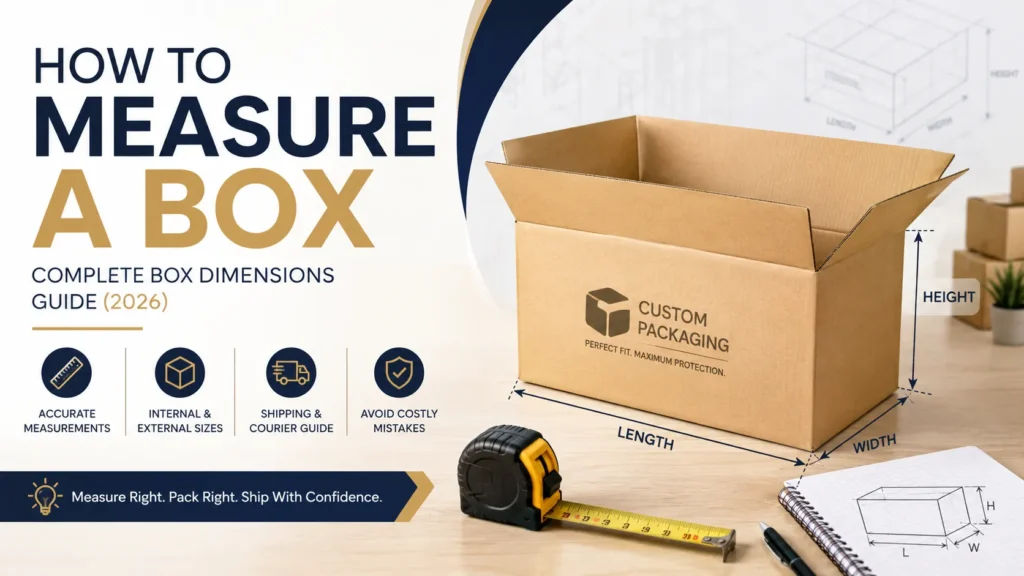
Length × Width × Height
- Length: The longest side of the box opening
- Width: The shorter side of the box opening
- Height: The distance from the base to the top
For example, a box measuring 30 cm along its longest side, 20 cm across its shorter side and 10 cm high should be written as:
30 × 20 × 10 cm
Always use the same unit for all three dimensions. In the UK, box and parcel measurements are usually provided in millimetres or centimetres.
Box Dimensions: Length, Width and Height
The order of box dimensions causes more confusion than the measuring itself. Length is not always the side facing you, and height is not simply the longest vertical-looking edge.
Length
The length is normally the longest side of the box opening.
For shipping parcels, major carriers also treat the longest side as the length. Parcelforce and UPS use this approach when calculating parcel size and girth.
Width
The width is the shorter side of the box opening.
It is measured at a right angle to the length. Width may also be referred to as breadth by some packaging suppliers.
Height
Height is the distance from the base of the assembled box to its top.
Depending on the box style, suppliers may also refer to this measurement as depth. Before approving custom packaging, check how the manufacturer labels each dimension on the dieline or quotation.
Measure the Product Before Measuring the Box
Custom packaging should be designed around the product in its final packed condition, not around a rough estimate.
Place the product on a flat surface in the position it will sit inside the box. Include anything that will be packed with it, such as:
- Product caps or lids
- Cables and accessories
- Instruction booklets
- Inner bags or sleeves
- Tissue paper
- Protective wraps
- Cardboard inserts
- Foam or moulded inserts
- Promotional cards
Measure the product at its widest points.
A bottle, for example, should be measured from the base to the top of the cap. A mug should include the handle. A cosmetic jar should include any lid that extends beyond the container.
Do not rely only on dimensions supplied by a manufacturer. Small changes to caps, closures, handles, or product assembly can affect the final fit.
How to Measure a Product for Custom Packaging
Follow these steps before ordering a custom box.
1. Prepare the Product as It Will Be Packed
Assemble the complete product presentation.
For a skincare gift set, this may include several bottles, an insert, an information card, and tissue paper. For an electronic device, it may include the charger, cable, and manual.
Measuring each item separately without planning their final arrangement can produce a box that is larger than necessary.
2. Choose the Packing Position
Decide whether the product will lie flat, stand upright, or sit at an angle.
The most attractive position is not always the most efficient. A tall upright box may look premium on a shelf but cost more to store and transport. A flatter layout may reduce space and make the package more stable.
3. Measure the Widest Points
Use a rigid ruler for small products or a tape measure for larger items.
Record:
- The longest product measurement
- The widest product measurement
- The tallest product measurement
Do not bend the measuring tape around curved surfaces. Measure the straight-line distance between the product’s outermost points.
4. Add Space for Protection and Inserts
A Custom box should not match the product measurements exactly unless the packaging design has been tested for a tight fit.
The required clearance depends on:
- Product fragility
- Board thickness
- Insert material
- Packing method
- Product weight
- Manufacturing tolerance
- Whether the box will be filled by hand or machinery
A rigid item in a folding carton may need only limited clearance. A fragile ceramic item may need space for cushioning on every side.
More space is not automatically safer. Excess movement can allow the product to hit the inside walls during transit.
5. Confirm the Internal Box Dimensions
The internal dimensions describe the usable space inside the finished box.
These are the most important measurements when checking whether the product and its inserts will fit.
Arrange the complete pack, measure the space it occupies, and add only the clearance needed for easy packing and safe handling.
6. Account for Packaging Material
Corrugated cardboard, rigid board and folding carton board have different thicknesses.
A box with internal dimensions of 300 × 200 × 100 mm will have larger external dimensions once the board thickness, folds and construction are included.
The difference may appear small, but it can affect:
- Outer shipping cartons
- Pallet layouts
- Warehouse shelf space
- Courier size categories
- Volumetric weight
- Postal charges
7. Test a Physical Sample
A digital dieline cannot fully show how a product will feel inside the finished box.
Test a plain sample before approving a large production run. Check that:
- The product enters without force
- The lid closes properly
- Inserts stay in position
- The product does not move excessively
- Printed areas align correctly
- The box survives normal handling
- The packed item meets courier limits
A sample can expose fitting problems before they become an expensive full-order issue.
Internal vs External Box Dimensions
Internal and external measurements serve different purposes.
| Measurement type | What it measures | Best used for |
| Internal dimensions | Usable space inside the assembled box | Checking product, insert and accessory fit |
| External dimensions | Full outside size of the assembled box | Shipping, storage, pallet planning and courier quotes |
| Product dimensions | Maximum size of the item being packed | Designing the correct internal box space |
When ordering custom packaging, clearly state whether your measurements are internal or external.
A supplier cannot safely assume which set you have provided. Confusing the two can result in packaging that is either too tight or unnecessarily large.
How to Measure a Cardboard Box
To measure an existing cardboard box accurately:
- Fully assemble the box.
- Close the bottom flaps.
- Keep the box square rather than allowing the sides to bow.
- Measure the longest side of the opening.
- Measure the shorter side of the opening.
- Measure from the base to the top.
- Record the figures as length × width × height.
- Label them as internal or external dimensions.
Do not include open flaps in the height. Measure the box as it will appear when closed.
For internal measurements, place the ruler against the inside walls. For external measurements, measure between the outermost surfaces.
How to Calculate the Volume of a Box
Box volume shows how much three-dimensional space the box occupies.
Use the formula:
Length × Width × Height = Box Volume
For a box measuring 40 × 30 × 20 cm:
40 × 30 × 20 = 24,000 cm³
To convert cubic centimetres into litres, divide by 1,000:
24,000 ÷ 1,000 = 24 litres
Volume is useful for:
- Comparing packaging sizes
- Planning warehouse storage
- Estimating vehicle capacity
- Checking large-parcel limits
- Calculating volumetric weight
- Reducing unnecessary packaging space
Parcelforce also calculates litre volume by multiplying the three dimensions in centimetres and dividing the result by 1,000.
How to Measure a Box for Shipping
Courier measurements should be taken after the product has been packed and the box has been sealed.
Measure the finished parcel at its widest points. Include:
- Bulges in the cardboard
- Protective corner pieces
- External wrapping
- Handles
- Protruding parts
- Raised tape or closures where relevant
Do not use the manufacturer’s stated box size if the packed parcel has changed shape.
For a clean rectangular parcel, measure:
Longest side × second-longest side × shortest side
Round carefully according to the courier’s booking rules. Under-reporting dimensions can lead to delayed shipments, adjustments or additional charges.
Royal Mail Small and Medium Parcel Dimensions
Royal Mail separates UK parcels by both size and weight.
| Royal Mail format | Maximum dimensions | Maximum weight |
| Small Parcel | 45 × 35 × 16 cm | 2 kg |
| Medium Parcel | 61 × 46 × 46 cm | 20 kg |
Royal Mail accepts UK parcels up to 20 kg. Parcels between 20 kg and 30 kg need to be sent through Parcelforce Worldwide instead.
These measurements are maximum limits, not recommended box sizes.
A parcel that exceeds one measurement may move into another category even when its total volume seems small. A long, narrow box can therefore fail a format test despite having less volume than a shorter box.
Check the selected service before finalising packaging because limits can differ between domestic, international and specialist services.
How to Calculate Parcel Girth
Girth measures the distance around the parcel’s two shorter dimensions.
For a rectangular box:
Girth = 2 × Width + 2 × Height
The length plus girth formula is:
Length + 2 × Width + 2 × Height
For a parcel measuring 100 × 30 × 20 cm:
- Length = 100 cm
- Girth = 30 + 20 + 30 + 20 = 100 cm
- Length plus girth = 200 cm
Parcelforce describes girth as the four shortest sides added together. UPS expresses the same calculation as length plus twice the width plus twice the height.
Girth becomes important for larger and irregular parcels because many courier services set a combined length-and-girth limit.
Actual Weight vs Volumetric Weight
Actual weight is the figure shown on the scales.
Volumetric weight estimates how much transport space the parcel occupies. A large but lightweight box can therefore cost more to send than a smaller parcel with the same actual weight.
DHL Express UK uses the following dimensional weight formula:
Length × Width × Height in centimetres ÷ 5,000
For a parcel measuring 40 × 30 × 20 cm:
40 × 30 × 20 ÷ 5,000 = 4.8 kg
If the parcel’s actual weight is 2 kg, its volumetric weight is 4.8 kg. DHL uses the greater of the actual and volumetric weights when calculating the delivery charge.
The divisor is not universal. Different carriers, services and freight types may use different methods. Use the selected courier’s own volumetric weight calculator UK tool before confirming the packaging design.
How to Measure an Irregular-Shaped Parcel
Imagine placing the irregular item inside the smallest rectangular box that could fully contain it.
Measure the imaginary box at the item’s outermost points:
- Longest point
- Widest point
- Highest point
Include handles, wheels, tubes, curved edges, and other protrusions.
UPS advises measuring irregular parcels from their longest points and using those measurements to calculate the cubic size.
Do not follow the curves of the object with the tape. Couriers normally assess the rectangular space the parcel occupies, not only the material surface.
Where possible, place an irregular product inside a regular corrugated shipping box. This can provide better protection, improve stacking, and reduce disputes over measurements.
How to Choose the Right Box Size for Shipping
The right shipping box protects the product with the least unnecessary space.
Consider five factors.
Product Protection
Fragile products may need cushioning, dividers, or reinforced corrugated board. Heavy items need packaging that can handle both their weight and movement during transit.
Product Movement
A box that is too large allows the contents to shift. A box that is too tight can transfer impacts directly to the product.
The aim is controlled protection, not simply the smallest possible box.
Packing Speed
Very tight packaging can slow down fulfilment. Staff may struggle to position inserts, close flaps or add accessories.
A slightly easier packing process can matter when hundreds of orders are handled each day.
Courier Limits
Compare the finished external dimensions with the selected courier’s parcel size and weight limits.
Do this before production, not after thousands of boxes have been manufactured.
Storage and Transport
Oversized packaging uses more warehouse space, more pallet space, and more vehicle capacity.
Smaller custom box dimensions can improve efficiency, but only when product protection remains adequate.
Standard Cardboard Box Sizes vs Custom Box Dimensions
Standard cardboard boxes are useful when speed and low initial cost are the main concerns. They are normally available quickly and can work well for mixed products.
However, “standard size” does not mean one universal UK measurement. Packaging suppliers offer different ranges, while couriers set their own parcel limits.
Custom packaging is more suitable when you need:
- A closer product fit
- Branded presentation
- Purpose-built inserts
- Less space
- Consistent packing
- Better shelf appearance
- More efficient shipping dimensions
- Protection for an unusual product shape
The decision should be based on the total packing and shipping process, not only the price of each empty box.
Common Box-Measuring Mistakes
Measuring Only the Product
The product measurement does not include inserts, cushioning, accessories, or packing clearance.
Mixing Millimetres and Centimetres
A measurement recorded as “250” means very different things depending on the unit. Mark the unit beside every figure.
Measuring a Flat Box
A flat cardboard blank does not show the finished internal or external box size. Assemble it first.
Ignoring Board Thickness
Thicker material increases the external size and reduces the usable internal space.
Measuring to a Rounded Edge
Use the widest outer point rather than estimating where a curved edge begins.
Forgetting the Final Shipping Layer
A printed Retail box may still need an outer corrugated box, void fill and protective corners. Courier measurements must cover the complete shipping parcel.
Choosing a Large Box “To Be Safe”
Extra space can increase movement, material use, storage demand and volumetric weight. Protection comes from a properly designed packaging system, not uncontrolled space.
Box Measurement Checklist
Before sending measurements to a packaging supplier, confirm:
- The product is in its final packed condition
- All accessories are included
- The packing orientation is decided
- Measurements cover the widest points
- The order is length × width × height
- Every figure uses the same unit
- Internal and external dimensions are clearly labelled
- Space for inserts and protection is included
- The material thickness has been considered
- The finished parcel fits the selected courier service
- Volumetric weight has been checked
- A physical sample will be tested before production
For custom packaging, accurate measurements are the starting point rather than the final decision. The box style, board grade, insert design, product weight and delivery method must work together.
99 Custom Boxes can help turn product measurements into practical packaging dimensions, including space for inserts, protection and branded presentation. Share your product size, packing arrangement and shipping requirements to discuss a suitable custom box structure.
Frequently Asked Questions
1. What order should box dimensions be written in?
Box dimensions are normally written as length × width × height. Length is the longest side of the opening, width is the shorter side, and height runs from the base to the top.
2. Should I provide internal or external dimensions for a custom box?
Provide the product dimensions and clearly state the required internal dimensions. The packaging manufacturer can then calculate the external size based on the material and box structure. Never send unlabelled measurements.
3. How much extra space should I add around a product?
Add only the space required for inserts, cushioning, manufacturing tolerance and easy packing. The correct allowance depends on the product and packaging material, so test a physical sample rather than applying one fixed amount to every box.
4. Do Royal Mail parcel dimensions include the packaging?
Yes. Measure the complete, sealed parcel rather than the product inside it. Include any external wrapping, bulges or protruding parts.
5. Can a lightweight parcel be charged at a higher weight?
Yes. Some couriers compare actual weight with volumetric weight and charge according to the higher figure. This is common when a parcel is large but light.
6. How do I measure a round or irregular product?
Measure the longest, widest and highest outer points as though the item were inside a rectangular box. Include handles, caps and other protrusions.
7. Are box dimensions measured from the inside or outside?
Both methods are used for different purposes. Internal dimensions confirm product fit, while external dimensions are used for shipping, storage and courier calculations.
8. Why should I order a sample before full production?
A sample confirms the actual fit, closure, insert position and packing experience. It can also reveal whether the finished external dimensions meet storage and courier requirements.