
 United States
A beautiful cosmetic label can still cause serious problems if essential information is missing, unclear, or printed in the wrong place. The result may be delayed launches, rejected retail listings, expensive packaging reprints, or action from Trading Standards.
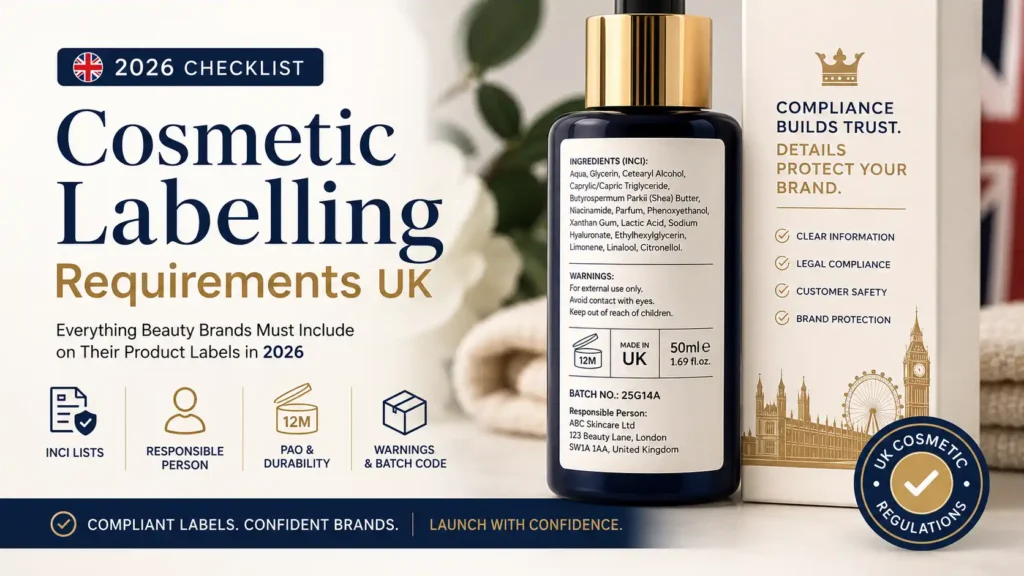
The cosmetic labelling requirements UK brands need to follow cover much more than an ingredient list. Before a beauty product reaches customers, the business must address product safety, legal responsibility, notification, traceability, claims and packaging presentation.
There is also an important geographical difference. England, Scotland and Wales follow the Great Britain cosmetic regime. Northern Ireland follows a separate process under rules linked to the Windsor Framework. Brands selling across the whole UK should confirm which requirements apply to each market before approving packaging.
What Must Be on a Cosmetic Label in the UK?
For a cosmetic product sold in Great Britain, the container and outer packaging will normally need to show:
- The name and address of the Responsible Person
- The country of origin for imported products
- The nominal weight or volume
- A minimum durability date or Period After Opening information
- Required warnings and precautions
- A batch number or other identification code
- The product’s function, when it is not obvious
- A complete ingredient list
The information must be clear, easy to read, and durable enough to remain legible during normal handling. Certain details must also appear in English.
| Label element | Why it matters | Common error |
| Responsible Person details | Identifies the party legally responsible for compliance | Printing only a website or PO Box |
| Country of origin | Required for imported cosmetics | Writing “Made in EU” instead of naming a country |
| Weight or volume | Tells buyers how much product they receive | Using the outer box dimensions instead |
| Durability or PAO | Shows how long the product remains suitable | Using an open-jar symbol without an approved period |
| Warnings | Helps customers use the product safely | Copying generic warnings from another formula |
| Batch code | Supports traceability and recalls | Using a code that cannot be linked to production records |
| Product function | Explains what an unclear product does | Calling a depilatory product only “cream” |
| Ingredients | Helps identify allergens and understand composition | Using marketing names instead of recognised ingredient names |
Labelling Is Only One Part of Cosmetic Compliance
A compliant box does not make an unassessed cosmetic product legal. Safety and regulatory work should come before the final artwork is sent to print.
A typical launch sequence is:
- Finalise the formulation.
- Confirm raw-material and fragrance documentation.
- Complete stability, compatibility and other required testing.
- Obtain the Cosmetic Product Safety Report.
- Prepare the Product Information File.
- Appoint or confirm the Responsible Person.
- Finalise the ingredient list, warnings and product claims.
- Create the packaging artwork.
- Notify the product through the correct portal.
- Approve the final print proof before production.
Changing the formulation after the artwork has been approved can affect the INCI list, allergen declaration, warnings, safety assessment and notification. A small ingredient change may therefore require more than a minor packaging edit.
The Responsible Person Name and Address
Every cosmetic product made available to consumers in Great Britain must have a Responsible Person. This may be:
- The manufacturer
- The importer
- A distributor selling the product under its own name or brand
- An authorised individual or company appointed for the role
The Responsible Person oversees compliance duties such as product safety, the Product Information File, notification, claims and corrective action.
The required name and address must normally appear on both the immediate container and the outer packaging. The details may be shortened only when the Responsible Person and address can still be clearly identified. When several addresses are displayed, the address where the Product Information File is readily accessible should be highlighted.
A website, email address or social media handle is not a substitute for the required postal address. GOV.UK guidance also states that a UK-established Responsible Person address should not be only a PO Box or mail-forwarding address.
A Temporary Labelling Provision Runs Until the End of 2027
The Responsible Person for the GB market must meet the GB legal requirements. However, transitional provisions allow certain EU or EEA Responsible Person details to continue satisfying specific label requirements until 31 December 2027.
Businesses should not treat this transition as a reason to delay planning. Packaging ordered in large quantities may remain in stock beyond the transition date. New designs should therefore be checked against the rules expected to apply throughout their intended production and sales period.
Country of Origin for Imported Cosmetics
The country of origin must be stated when a cosmetic product is imported into Great Britain.
The wording should identify a country. “Made in the EU” is not accepted as a country-of-origin statement because the European Union is not a country.
This detail can become complicated when:
- The formula is made in one country and filled in another
- Components are assembled across several locations
- Bulk product is imported and packed in the UK
- A UK brand uses an overseas contract manufacturer
The business should confirm the correct origin with its manufacturer, importer or compliance adviser before printing thousands of cartons.
Net Weight or Volume
The label normally needs the nominal contents at the time of packaging, shown by weight or volume.
Examples include:
- 50 ml
- 30 g
- 100 ml
- 15 g
Some exemptions may apply to:
- Packs containing less than 5 g or 5 ml
- Free samples
- Single-application sachets
- Products normally sold by number, where the item count is clear
An exemption should be confirmed rather than assumed. Free samples still count as supplied cosmetic products and remain subject to the other relevant cosmetic rules.
When planning the artwork, avoid placing the quantity statement across folds, curved edges, glue flaps or areas hidden by seals. It may technically exist on the design file but become difficult to read once the box is assembled.
Cosmetic Expiry Date vs PAO
One of the most common mistakes is treating the best-before date and the Period After Opening symbol as interchangeable.
They serve different purposes.
Products With Durability of 30 Months or Less
A cosmetic likely to deteriorate within 30 months normally needs a date of minimum durability.
The label may use:
- The words “best used before the end of”
- The hourglass symbol
- The date itself
- A clear statement showing where the date appears
Any storage condition needed to maintain that durability should also be included.
Products With Durability of More Than 30 Months
A product with durability longer than 30 months will generally use the PAO symbol when deterioration after opening could create a safety concern.
The PAO symbol cosmetics brands often use is an open jar with a period such as:
- 6M
- 12M
- 18M
- 24M
The period must come from the product’s safety and stability information. It should not be selected because another brand uses the same number.
The open-jar symbol may not be relevant for products that do not deteriorate in a way that could harm the user after opening. Examples may include single-use products, products that do not physically open, and certain aerosols.
Batch Number Requirements
A batch code links a product to its manufacturing records. It is essential for investigating complaints, checking affected stock, and managing a withdrawal or recall.
A useful batch code should allow the business to identify information such as:
- Production date
- Manufacturing location
- Formula or product version
- Raw-material records
- Filling or packing run
- Quality-control results
The batch number normally appears on both the immediate container and outer packaging. When the container is too small, it may appear on the outer packaging alone.
Leave Space for Variable Data
Batch codes are often printed or stamped after the main packaging has been produced. The box design should include a clean area for variable information.
Avoid placing the batch area:
- Over dark illustrations
- Across textured foil
- On heavily laminated folds
- Close to glue seams
- Where a retail sticker may cover it
- On a panel likely to rub during transport
A light, uncoated patch may improve ink adhesion and scanning. The right solution depends on the printing method, board finish, and coding equipment.
Cosmetic Ingredient List Requirements
The ingredient list may appear on the outer packaging only. When there is no outer box, it must normally appear on the container or through another permitted presentation method.
The list should be headed by the word “Ingredients,” and use recognised common ingredient names, usually INCI names.
INCI stands for International Nomenclature of Cosmetic Ingredients. It creates a consistent naming system that helps customers recognise ingredients across different brands and countries.
Marketing names should not replace the proper INCI declaration. For example, a brand may promote “rose hydration complex” on the front of the box, but the ingredients panel must identify the substances that actually make up that complex.
Cosmetic Ingredient Order on the Label
Ingredients are generally listed in descending order by weight, based on the point when they are added to the formulation.
The 1% rule for cosmetic ingredients allows ingredients present at less than 1% to appear in any order after ingredients present at 1% or more.
Other important points include:
- Mixtures should be broken down into their individual components.
- Perfume compositions are usually identified as “Parfum”.
- Flavour or aromatic compositions may use “Aroma”.
- Colourants may follow the other ingredients.
- Colour cosmetics sold in several shades may use “may contain” or “+/-” for permitted variable colourants.
- Nanomaterial ingredients should include “(nano)” after the relevant ingredient name.
The final ingredient list should come from the approved formulation and compliance records, not from an early product brief.
Fragrance Allergen Labelling
Writing only “Perfum” is not always enough.
Certain fragrance substances must be declared individually when they exceed the relevant threshold. Current GB guidance identifies declaration thresholds of:
- 0.001% in leave-on products
- 0.01% in rinse-off products
These substances may be present in a fragrance compound or occur naturally within essential oils. Brands need accurate allergen information from fragrance houses, essential-oil suppliers and manufacturers before producing the ingredient panel.
A supplier document should also match the exact fragrance version used in production. Similar fragrance names do not guarantee an identical allergen profile.
Warnings and Precautions
Warnings must reflect the product’s ingredients, intended use and foreseeable risks. They may be based on:
- Restrictions attached to particular ingredients
- Conclusions in the Cosmetic Product Safety Report
- Professional-use conditions
- Storage requirements
- Application areas
- Age limitations
- Exposure time
- Rinse-off instructions
Required warnings normally need to appear on both the immediate container and outer packaging in English.
Generic phrases such as “for external use only” do not replace formula-specific warnings. Likewise, copying precautions from a competing product can be unsafe because its ingredients, concentration, and use conditions may differ.
The Product Function Must Be Clear
The label must state what the product does when its function is not obvious from its presentation.
“Lipstick” and “shampoo” are usually self-explanatory. Names such as “Radiance Renewal”, “Silk Drops” or “Perfect Finish” may not tell the customer whether the product is a serum, hair oil, cleanser or make-up primer.
A clear descriptor can solve the problem:
- Hydrating face serum
- Rinse-off hair conditioner
- Facial cleansing balm
- Tinted lip balm
- Body exfoliating scrub
Clear product descriptions also improve customer understanding and reduce the risk of misuse.
Cosmetic Claims Must Be Supported
Claims printed on the box, bottle, website and advertising should not suggest that the product has a feature or function it does not possess.
Cosmetic claims should meet principles including:
- Legal compliance
- Truthfulness
- Evidence support
- Honesty
- Fairness
- Informed decision-making
A claim about one ingredient should not automatically be applied to the finished product. For example, evidence that an ingredient has moisturising properties does not by itself prove that the finished formula provides a specific 24-hour moisturising benefit.
Higher-risk claims, such as sun protection claims, normally require stronger evidence because poor performance could affect safety.
Be cautious with wording that may make a cosmetic sound medicinal. Phrases such as “treats eczema”, “heals acne” or “prevents infection” can change how regulators interpret a product.
Safer cosmetic wording must still be truthful and supported. Examples may include “helps the skin feel softer” or “cleanses excess surface oil” when appropriate evidence exists.
CPSR, PIF and SCPN: What the Terms Mean
These three terms are often confused, but they cover different parts of compliance.
Cosmetic Product Safety Report
A Cosmetic Product Safety Report, commonly called a CPSR, assesses whether the finished cosmetic is safe under normal and reasonably foreseeable use.
It has two main parts:
- Safety information about the product, ingredients and exposure
- The qualified safety assessor’s conclusions and reasoning
The safety assessor may need formulation details, ingredient specifications, toxicological data, stability information, microbiological information and packaging compatibility data.
The CPSR should be completed before the product is made available to consumers.
Product Information File
The Product Information File, or PIF, is the broader technical record maintained by the Responsible Person.
It includes:
- A description of the cosmetic product
- The Cosmetic Product Safety Report
- Evidence of good manufacturing practice
- Evidence supporting claimed effects
- Other required product information
For GB products, the PIF must be kept in English and remain available for 10 years after the last batch was made available.
Submit Cosmetic Product Notification
Before a new cosmetic product is placed on the GB market, the Responsible Person must submit the required details through the Submit Cosmetic Product Notification service, often called SCPN.
Information may include:
- Product name and category
- Responsible Person details
- Location of the PIF
- Ingredient information
- Details of certain substances or nanomaterials
- An image of the label
- A photograph of the packaging
Northern Ireland uses a separate notification process.
Selling Homemade Cosmetics in the UK
The same core safety and compliance duties apply whether products are made by a large factory or in a small workshop.
A handmade business may still need to:
- Follow good manufacturing practice
- Use suitable production and storage areas
- Keep batch records
- Obtain a CPSR
- Maintain a PIF
- Appoint a Responsible Person
- Notify each relevant product
- Print compliant labels
- Support its marketing claims
- Manage complaints and adverse effects
Giving a product away does not automatically remove these duties. Samples supplied at markets, through subscription boxes or with online orders may still fall within the cosmetic rules.
Small brands often save money by ordering packaging early. However, printing before the CPSR and final ingredient documentation are approved can turn that saving into waste. Start structural design early, but hold final regulatory copy until the compliance information is stable.
Soap Labelling Requirements
Soap intended to clean, perfume or care for the skin is commonly treated as a cosmetic product. It therefore needs the relevant safety assessment, product information, notification and labelling.
The product’s intended purpose and claims matter. A handmade soap sold as a skin cleanser is different from a product promoted to disinfect surfaces or kill harmful organisms.
For cosmetic soap packaging, allow room for:
- Product function
- Net weight
- Responsible Person details
- Ingredient list
- Fragrance allergens
- Batch code
- Durability information
- Warnings where required
Paper bands may look attractive but offer limited print space and protection. A carton can create more room for readable ingredients, branding and required information while helping protect the bar from handling and contamination.
Small Cosmetic Product Labelling
Lip balms, mini perfumes, sample pots, eye products and single-use sachets create genuine space problems.
When it is not practical to place all warnings or ingredients directly on the package, permitted alternatives may include:
- An enclosed leaflet
- An attached label
- A tag
- A tape
- A card
The hand-and-book symbol can direct customers to enclosed or attached information. The symbol does not remove the need to supply that information.
Outer cartons are especially useful for small containers because they create a larger, flatter print area. However, information that must appear on the immediate container should not be moved to the box without confirming that an exception applies.
Packaging Decisions That Improve Compliance and Usability
Good cosmetic packaging makes required information easier to find, read, and keep.
Use a Clear Information Hierarchy
A practical carton might use:
Front panel
- Brand name
- Product name
- Product function
- Key supported benefit
- Net contents
Side panel
- Directions
- Warnings
- Storage information
Back panel
- Ingredients
- Responsible Person details
- Country of origin
- Symbols
Top or bottom panel
- Batch code
- Date or PAO information
- Barcode
The exact layout depends on the box shape and container, but grouping related information makes the packaging easier to scan.
Design at the Finished Size
Artwork can look readable when enlarged on a monitor but become too small once printed.
Always review:
- A full-size artwork proof
- The assembled box shape
- Text close to folds and cut lines
- Contrast between type and background
- Foil or varnish over small text
- Barcode quiet zones
- Batch-code print areas
Plan for Formula and Regulatory Changes
Avoid ordering several years of packaging when the formula, claims or legal requirements may change.
Lower initial quantities can be useful for:
- New brands
- Product testing
- Seasonal ranges
- Formula launches
- Retail trials
- Rebranding projects
Once the product and artwork are stable, larger quantities may reduce the cost per box.
Cosmetic Labelling Checklist UK Brands Can Use
Before sending cosmetic packaging to print, confirm that:
- The formula matches the approved CPSR.
- The Responsible Person has approved the regulatory copy.
- The correct name and address appear in the required locations.
- Imported products show the correct country of origin.
- The nominal weight or volume is accurate.
- The correct best-before or PAO information is used.
- Warnings match the safety report and ingredient restrictions.
- A usable batch-code area is available.
- The product function is clear.
- The INCI list matches the final formula.
- Fragrance allergens have been checked.
- Nanomaterials are marked correctly where applicable.
- All required English text is clear and readable.
- Claims have suitable evidence.
- The assembled box has been checked at full size.
- The product has been notified through the correct service.
- The artwork version and approval date are recorded.
How Custom Packaging Supports a Compliant Beauty Launch
Compliance information often competes with branding for limited space. A made-to-measure outer box creates room for both without reducing every legal detail to tiny print.
Custom cosmetic packaging can help brands:
- Separate directions, warnings, and ingredients into clear panels
- Protect glass bottles, jars and tubes during delivery
- Add a suitable area for batch coding
- Improve shelf presentation
- Keep small containers from moving inside the carton
- Build a consistent look across skincare or make-up ranges
- Select board and finishes suited to retail or e-commerce handling
99 Custom Boxes supplies custom cosmetic boxes in different sizes, structures, stocks and print formats, with design support available for packaging projects. The packaging team can help organise practical panel space and dielines, while the brand’s Responsible Person or compliance professional should approve the final regulatory content.
Once the formula, label copy and required approvals are ready, Request a custom quote or packaging sample to check the size, structure and print layout before placing a full order.
Final Check Before Printing
Cosmetic packaging should not be treated as the final decoration added at the end of product development. It is part of the safety, traceability and customer-information system.
The safest workflow is to complete the formulation, safety assessment and compliance records first. The approved information can then be organised into packaging that is clear, attractive and practical to manufacture.
A well-planned cosmetic box protects more than the bottle or jar. It protects the product launch from avoidable delays, reprints and customer confusion.
Regulatory References
Frequently Asked Questions
1. Are cosmetic labelling rules the same across the whole UK?
Not completely. England, Scotland and Wales follow the Great Britain regime. Northern Ireland follows a separate process under the Windsor Framework. Brands selling in both markets should check the requirements for each route.
2. Do homemade cosmetics need a CPSR?
Yes. A cosmetic product must be safety assessed before it is made available to consumers. Small-scale or handmade production does not create a general exemption.
3. Can the ingredient list appear only on the outer box?
The ingredient list normally appears only on the outer packaging. When there is no outer box, another compliant method is required.
4. Do free cosmetic samples need labels?
Free samples are still treated as supplied products. Some limited exemptions may apply to nominal quantity or durability information, but other safety, notification and labelling duties can still apply.
5. What is the difference between an expiry date and a PAO symbol?
A minimum durability date applies mainly to products with durability of 30 months or less. A PAO symbol shows the safe period of use after opening for longer-lasting products where it is relevant.
6. Can common English ingredient names be used instead of INCI names?
The ingredient panel should use recognised common cosmetic ingredient names, normally INCI names. Consumer-friendly names may appear elsewhere but should not replace the compliant declaration.
7. Does a cosmetic label need a UK address?
The GB Responsible Person must meet the applicable establishment requirements. Transitional label provisions may allow certain EU or EEA details until 31 December 2027, but brands should plan for the end of that period.
8. Can a packaging printer confirm that a cosmetic label is legally compliant?
A packaging supplier can check print quality, layout, dimensions and whether supplied content fits the carton. Legal responsibility for the cosmetic product and label remains with the Responsible Person. Final regulatory copy should be approved before printing.