

 United States
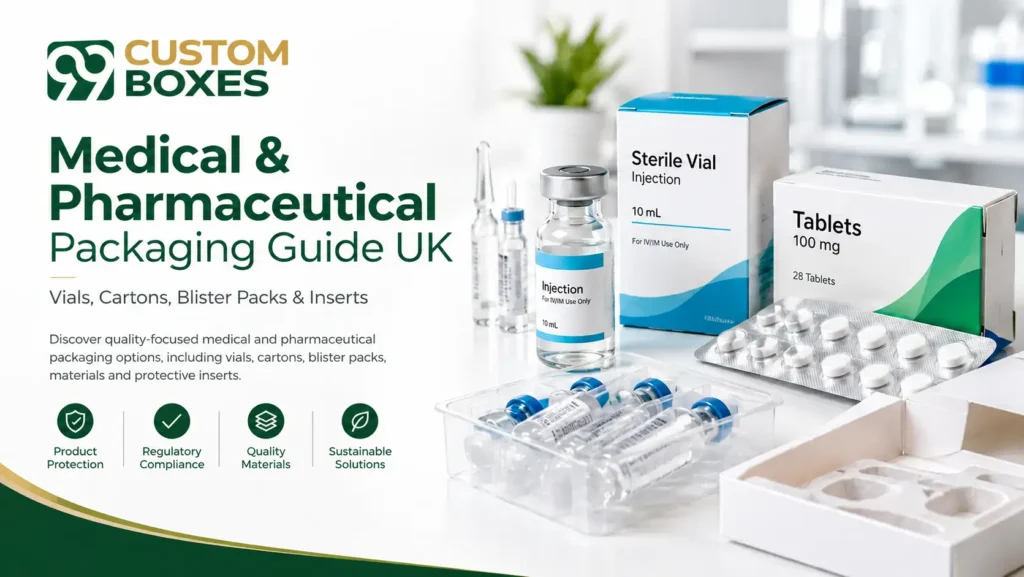
Medical and pharmaceutical packaging has a job that goes far beyond making a product look professional. The packaging may need to protect a medicine or medical device, support safe handling, provide essential information, resist tampering, and withstand storage and transport conditions.
The right format depends on what is being packaged. A tablet may need a blister pack and carton, while an injectable product may require a vial, closure, label, insert, and protective outer box. Medical devices can have different requirements again, particularly where sterility or controlled handling is involved.
For UK businesses, packaging decisions also need to account for applicable regulatory requirements. The Medicines and Healthcare products Regulatory Agency (MHRA) provides specific guidance on medicines packaging, labelling, patient information leaflets and child-resistant packaging. Medical devices are regulated under a separate framework.
The most useful way to approach Medical & Pharmaceutical Packaging is therefore to start with the product, then work outward to protection, information, packaging format and compliance.
What Is Medical & Pharmaceutical Packaging?
Medical and pharmaceutical packaging is the combination of containers, closures, cartons, labels, inserts and protective structures used to contain, protect, identify and present medicines or medical products.
It can be divided into three broad levels:
| Packaging level | Main purpose | Typical examples |
| Primary pharmaceutical packaging | Directly contains the medicine or product | Vials, bottles, blister packs, ampoules |
| Secondary pharmaceutical packaging | Protects and presents the primary pack | Folding cartons, sleeves, printed outer boxes |
| Tertiary pharmaceutical packaging | Supports handling, storage, and distribution | Shipping cases, outer transit cartons, pallets |
This distinction matters because each layer solves a different problem.
A primary container has direct contact with the product. A secondary carton can provide additional protection while carrying important printed information. Tertiary packaging is primarily concerned with movement through warehouses and distribution channels.
One common mistake is treating the outer carton as the entire packaging system. In practice, the carton may be only one part of a much larger packaging configuration.
What Are the Main Types of Pharmaceutical Packaging?
The most suitable pharmaceutical packaging types depend on the dosage form, product sensitivity, route of administration, expected handling, and required information.
Common formats include:
Blister Packaging
Blister packs are widely used for tablets and capsules. Individual cavities separate doses and can provide a convenient way to organise medication.
Different blister packaging types use different combinations of materials. Plastic films and aluminium foil are commonly used, while aluminium-based structures can provide a different level of barrier protection.
A blister format may make sense when:
- Doses need to remain separated.
- Unit-dose presentation is useful.
- The medicine needs a compact retail format.
- The packaging needs to make individual doses easy to identify or access.
The material choice should not be made simply because one option is more popular. Product sensitivity, shelf-life requirements, sealing performance, and regulatory considerations all need to be assessed.
Pharmaceutical Bottles
Bottles are commonly used for tablets, capsules, liquids, and other products where a container with a closure is more appropriate than a blister pack.
The packaging system can include the bottle, cap or closure, seal, label and sometimes an outer carton.
For certain medicines, the closure can also be part of the child-resistant packaging system. UK guidance specifically addresses child-resistant requirements and references standards including BS EN ISO 8317 for reclosable packaging and BS EN 14375 for non-reclosable packaging.
Vial Packaging
Vials are especially important for injectable medicines, laboratory products and other products supplied in small containers.
A vial packaging system can include:
- The vial itself
- Closure and seal
- Printed label
- Internal support
- Protective carton
- Information insert where required
Glass vials create a particular packaging challenge because the contents may be valuable while the container itself is fragile. The outer packaging therefore needs to reduce unnecessary movement and provide suitable support.
For businesses looking specifically at the external box, Custom Vial Packaging Boxes are a consideration when the objective is to create a box around the vial or vial configuration.
Pharmaceutical Carton Packaging
A pharmaceutical carton is usually a secondary packaging component rather than the primary container.
The carton can provide space for product identification, warnings, instructions, and other required information while also protecting the inner package.
For UK medicines, packaging and labelling are closely connected to regulatory compliance. MHRA guidance states that information on packaging for licensed medicines must be printed directly onto the packaging and that medicines must include a patient information leaflet when the necessary information is not all present on the label.
That means carton artwork is not simply a branding exercise. Regulatory text, readability and layout need to be considered from the beginning.
Inserts and Internal Supports
Packaging inserts can have a practical role when products need to remain separated, positioned, or protected inside an outer box.
For example, an insert may help organise several vials within one carton or prevent smaller containers from moving excessively.
However, an insert should not be added automatically. It adds another component to the packaging system, which can affect material use, assembly time, recycling, and overall cost.
Before selecting an insert, consider the actual reason it is needed: positioning, separation, presentation, or protection.
You can also compare different insert materials in this Packaging inserts material comparison guide.
Primary vs Secondary vs Tertiary Pharmaceutical Packaging
The difference becomes much easier to understand when you look at a real example.
Imagine a medicine supplied as tablets:
Primary: blister strip containing the tablets
Secondary: printed carton containing the blister
Tertiary: shipping case used to transport multiple cartons
For a vial-based product:
Primary: vial and closure
Secondary: protective printed carton with suitable internal support
Tertiary: transport packaging used to move multiple packed units
The key insight is that packaging protection should be considered as a system, not as a single box.
A stronger outer carton cannot compensate for an unsuitable primary container. Likewise, a good primary container can still arrive damaged if the secondary and tertiary packaging do not provide suitable protection during handling and transport.
Which Pharmaceutical Packaging Materials Are Commonly Used?
Material choice depends on the product and the role of each packaging layer.
Glass
Glass is commonly associated with pharmaceutical bottles, vials, and ampoules. It offers useful barrier and compatibility properties for certain applications, but it is also heavier and more fragile than many plastic alternatives.
Plastic
Plastic materials are used in bottles, blister components, trays, and other packaging applications. Different polymers behave differently, so “plastic” should not be treated as one single packaging material.
Aluminium
Aluminium can be used in pharmaceutical packaging structures, including blister foil and certain barrier applications. Aluminium-based blister structures are particularly relevant where protection from moisture, light or oxygen is an important consideration.
Paperboard and Cartonboard
Paperboard is widely used for secondary packaging such as folding cartons. Its major advantage in this context is the combination of printable surface area and structural protection.
It also provides room for product information without putting all printed information onto the primary container.
Sustainable Packaging Materials
Lower-impact material choices are increasingly part of packaging discussions, but sustainability should not come at the expense of the product’s actual requirements.
A smaller carton, lighter material, or simplified insert may reduce unnecessary material use. However, reducing packaging that is performing a genuine protective function can create a different problem.
The better question is not simply “Which material is most sustainable?”
It is:
“What is the lowest-material packaging system that still performs the required protection, information, and handling functions?”
How Do You Choose Between Blister, Bottle and Vial Packaging?
There is no universal best format.
| Format | Usually makes sense when | Main consideration |
| Blister | Individual doses need separation and convenient access | Sealing and material selection |
| Bottle | A larger quantity needs to be contained together | Closure and protection system |
| Vial | Product is supplied in a small container, often for injectable or specialist use | Fragility, closure and handling |
| Carton | Primary packaging needs an outer printed/protective layer | Structure, artwork and information |
| Carton + insert | Multiple or fragile items need controlled positioning | Fit, assembly and material use |
A useful decision rule is to start with the product behaviour, not the appearance of the box.
Ask:
- What exactly is being packaged?
- Does the primary container already provide the necessary protection?
- How much movement can the product tolerate?
- Does the package need individual-dose presentation?
- Will the package be stored, shipped, or handled frequently?
- What information must appear on the pack?
- Does the packaging need child-resistant or tamper-evident features?
- Is sterility part of the product’s packaging requirements?
These questions usually narrow the options much faster than starting with a preferred box style.
What Are Tamper-Evident and Child-Resistant Pharmaceutical Packaging?
These terms describe different packaging functions.
Tamper-evident packaging is designed so that an attempt to open or interfere with the pack can be detected.
Child-resistant packaging is designed to make opening difficult for young children while remaining usable by the intended user.
They should not be treated as interchangeable.
For UK medicines, MHRA guidance sets specific requirements around child-resistant packaging for certain medicines, including products containing aspirin, paracetamol and more than 24mg of elemental iron, subject to stated exceptions. The guidance also explains that changes to packaging materials, adhesives or blister configurations can affect the child-resistant properties of a system.
This leads to an important practical point: changing a packaging component can change the performance of the complete packaging system.
For regulated products, packaging changes should therefore be reviewed carefully rather than treated as a purely cosmetic redesign.
What Are the UK Medicine Packaging Regulations?
UK medicine packaging has specific regulatory requirements, and these should be checked against the exact product and licensing situation.
The MHRA states that it approves packaging and labelling information for medicines sold in the UK. Its guidance covers areas including labelling, patient information leaflets, warnings, Braille, child-resistant packaging and submissions for changes to packaging artwork.
The MHRA’s best-practice guidance also explains that the legal framework for medicines labelling and packaging is based on UK legislation, including the Human Medicines Regulations 2012 as amended.
There are also UK-specific packaging considerations following changes to the Windsor Framework. For medicinal products, the MHRA guidance states that from 1 January 2025, UK medicinal products placed on the market must carry a clearly legible “UK Only” label, with specific requirements for how that label is presented.
Because regulatory requirements can depend on the product, market and regulatory route, packaging suppliers should not be treated as substitutes for regulatory review. A packaging printer can produce the structure and artwork, but the responsible manufacturer or marketing authorisation holder remains responsible for regulatory compliance.
What About Medical Device Packaging in the UK?
Medical device packaging should not simply be treated as pharmaceutical packaging under a different name.
Medical devices have their own regulatory framework. The MHRA states that medical devices placed on the Great Britain market must have the applicable UKCA or CE marking depending on the legislation under which the device has been certified, and relevant labelling requirements can include information about the UK responsible person and applicable conformity assessment details.
For sterile devices, packaging has another critical function: maintaining the sterile condition until the product is used.
That makes sterile medical device packaging a more specialised requirement than ordinary printed outer packaging.
The packaging system may need to account for:
- Sterility maintenance
- Seal integrity
- Handling during transport
- Shelf-life considerations
- Instructions for use
- Device identification
- Applicable regulatory markings
Businesses working with medical devices should therefore establish the applicable regulatory and packaging requirements before finalising a box structure or printed artwork.
How Should Pharmaceutical Packaging Artwork Be Planned?
Pharmaceutical packaging needs a different design mindset from ordinary retail packaging.
A consumer product may give branding a large amount of space. A regulated medicine may need to reserve substantial space for mandatory information.
Start by confirming:
Product information → regulatory text → warnings → identification → accessibility → branding
Rather than designing the front panel first and trying to squeeze the required content in later.
MHRA guidance specifically addresses readability, warnings, Braille, and patient information. It also states that the name of the medicine must be displayed in Braille on the labelling of medicines.
For the printing stage, your Custom Box Printing Guide UK can help with practical topics such as dielines, colour systems, artwork preparation and finishing.
The important distinction is that print quality and regulatory compliance are separate checks. A beautifully printed carton can still have incorrect or incomplete regulatory information.
How Can Inserts Improve Medical Packaging?
Inserts are useful when the internal arrangement of a product matters.
For example, a carton containing several small vials may benefit from individual compartments. A delicate item may also need internal positioning to minimise movement.
But inserts should be designed around the product dimensions.
An insert that is too loose may allow movement. An insert that is too tight can make packing and removal difficult. An unnecessarily complex insert can also increase assembly time and material consumption.
This is why fit matters more than appearance.
For multiple products or irregular shapes, consider custom dimensions rather than forcing a standard box around the contents. Your Custom Size Boxes vs Standard Boxes guide covers the broader trade-off between exact-fit packaging and off-the-shelf sizes.
Common Mistakes When Choosing Pharmaceutical Packaging
A few packaging decisions create problems repeatedly.
Choosing the outer box before understanding the primary package
The carton dimensions, insert design, and protective structure should follow the actual product configuration.
Treating packaging as purely decorative
Medical and pharmaceutical packaging often carries functional and regulatory information. Visual branding should work around those requirements rather than compete with them.
Assuming all glass containers need the same protection
A small vial, a larger bottle and a fragile ampoule do not necessarily have identical packaging needs.
Changing materials without reviewing the whole system
A change in blister material, foil, adhesive or closure can affect package performance. MHRA guidance specifically highlights this in relation to child-resistant packaging.
Reducing material without considering product protection
Less material is not automatically better if the result increases breakage, handling damage or product loss.
Leaving compliance checks until after artwork approval
Regulatory information can affect panel sizes, hierarchy, typography and layout. It should be considered before the artwork becomes difficult to change.
A Practical Checklist for Medical & Pharmaceutical Packaging
Before approving a packaging structure, work through this checklist:
- Product: What medicine, device or healthcare product is being packaged?
- Primary pack: What directly contains the product?
- Protection: What risks exist during storage and transport?
- Format: Would a vial, bottle, blister, carton, or another structure be appropriate?
- Materials: Are the materials suitable for the intended application?
- Security: Is tamper evidence or child resistance required?
- Information: What information must appear on the package?
- Accessibility: Are readability and relevant accessibility requirements addressed?
- Internal support: Does the product need inserts or compartments?
- Dimensions: Is the box sized around the actual contents?
- Regulatory review: Has the responsible regulatory party checked the final packaging and artwork?
- Sustainability: Can unnecessary material be removed without reducing required performance?
This checklist separates three issues that are often mixed: what the product needs, what the packaging must do, and what the regulations require.
That separation makes packaging decisions much easier.
Where Does Custom Packaging Fit In?
Custom packaging can be useful when standard packaging does not provide the required fit, presentation, or internal arrangement.
For example, a custom outer carton may be useful for:
- Specific vial dimensions
- Multiple-unit vial configurations
- Special insert layouts
- Brand-specific carton artwork
- Unusual product dimensions
- Retail presentation requirements
99 Custom Boxes provides packaging options including Medical Boxes and Custom Vial Packaging Boxes, which are relevant when a business needs an external box designed around a medical or vial-based product. The company’s vial packaging page describes custom sizing, inserts, printing and finishing options for vial boxes.
The right approach is to define the packaging requirements first and then select the box structure, material and finish that support them.
For broader packaging sustainability considerations, see the Sustainable Packaging Guide UK.
Making the Right Medical Packaging Decisions
Choosing Medical & Pharmaceutical Packaging is not simply a question of picking a box style.
The better process is to start with the product and work outward: identify the primary package, understand the protection required, select suitable materials, determine whether secondary packaging or inserts are needed, and then review the artwork and regulatory requirements.
For UK medicines, the MHRA provides detailed guidance on packaging and labelling, while medical devices follow their own regulatory framework.
For businesses developing external packaging, options such as Medical Boxes, Custom Vial Packaging Boxes, custom sizing, and packaging inserts can provide a practical starting point. The final structure should always be selected around the product’s actual requirements rather than around appearance alone.
Frequently Asked Questions
1. What is the difference between primary and secondary pharmaceutical packaging?
Primary packaging directly contains the medicine, such as a vial, bottle or blister. Secondary packaging usually surrounds the primary package, such as a printed carton.
2. What is tertiary pharmaceutical packaging?
Tertiary packaging is used mainly for storage, handling, and distribution. Examples include outer shipping cases used to move multiple packaged products.
3. What are the common types of pharmaceutical packaging?
Common formats include blister packs, bottles, vials, ampoules, cartons, tubes, sachets, and other specialised containers. The appropriate option depends on the medicine and its packaging requirements.
4. What materials are used for pharmaceutical packaging?
Common materials include glass, plastics, aluminium, paperboard and combinations of these materials. The correct choice depends on product compatibility, barrier needs, protection and regulatory requirements.
5. Is pharmaceutical packaging regulated in the UK?
Yes. UK medicines packaging and labelling are subject to specific requirements. The MHRA provides guidance covering packaging, labelling, patient information leaflets, warnings, Braille and child-resistant packaging.
6. Is medical device packaging regulated separately?
Yes. Medical devices are subject to a separate UK regulatory framework. Requirements can include applicable conformity markings, labelling and information relating to the responsible parties.
7. What is tamper-evident pharmaceutical packaging?
Tamper-evident packaging is designed to make signs of opening or interference detectable. It serves a different purpose from child-resistant packaging, which is designed to make access difficult for young children.
8. Are inserts useful for vial packaging?
They can be useful when vials need separation, positioning, or additional support inside an outer carton. The insert should be designed around the actual vial dimensions and the protection required.
9. Can custom boxes be used for medical products?
Custom outer boxes can be appropriate for medical and vial-based products when the packaging structure needs a particular size, layout, insert, or printed presentation. The specific regulatory suitability of the complete packaging system still needs to be established by the responsible product manufacturer.